Choose the smallest slicer that accommodates your actual food and permitted workload, then check whether you can clean and store it comfortably. A larger blade is useful only if the carriage, food clearance and operating instructions also suit your task.
This CUSIMAX listing distinguishes itself with two removable 8.7-inch blades and a removable food carriage. It advertises a 1–20mm adjustment range. The practical question is whether the food-contact components you must wash can be removed in a way you are comfortable repeating after each session.
The NutriChef entry lists a 200W motor, removable 7.5-inch blade, food pusher and a 0–15mm thickness dial. Its compact-blade format belongs on a home-use shortlist where modest batches and post-use cleaning matter more than commercial throughput claims.
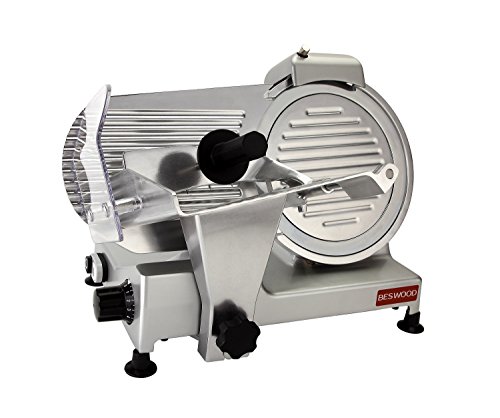
The BESWOOD250 occupies the step between a lightweight food slicer and a larger deli machine. Its listing identifies a 10-inch chromium-plated blade and 240W motor. The buying decision is whether that larger format earns its place on your counter through regular slicing, rather than whether a bigger blade looks more professional.
Treat electrical power as a supporting specification
Inspect the cleanup path before the attractive features
Use the catalog to compare different kinds of compromise
Make a pass-or-fail shortlist before ranking preferences
Questions to answer before placing an order
A home slicer can be an excellent sandwich-making appliance and a frustrating purchase for someone who expected it to cut everything in the refrigerator. The difference often starts with the shopping brief. “A powerful slicer” is too vague. “A slicer for one cooked boneless roast every Sunday, kept in a lower cabinet” gives you a useful set of decisions.
This guide works backward from that real task. It does not assign an overall winner to machines we have not tested. The products linked with this article are examples from the catalog; their listing descriptions help establish the initial shortlist, while the exact model documentation must settle compatibility and operating limits.
Write a three-food shopping brief
List the three foods you are most likely to slice, in the form in which they reach the machine. A whole cooked roast is different from a short salami, and both differ from a wide slab of bacon. Record whether each is raw or cooked, its approximate height and length, and the thickness you want after cutting. Measure the food itself rather than its packaging.
Next to each food, write how often it appears in your kitchen. The main weekly task deserves more weight than something you might try once. This prevents an occasional ambitious project from making every ordinary session harder. A machine bought around a hypothetical oversized roast may occupy more space than your everyday routine justifies.
Your routine
First question to resolve
Reason
One boneless cooked roast each week
Will the entire cross-section fit?
Repositioning food can defeat the slice shape you wanted.
Several small sandwich ingredients
Can you change foods and clean accessible parts easily?
Handling overhead matters as much as cutting speed.
Large jerky sessions
Does the permitted duty cycle fit the batch?
A small motor specification does not describe usable session duration.
Occasional hot-pot preparation
Is the required food state explicitly permitted?
Not every electric slicer accepts the preparation used by a lever cutter.
Separate capacity from blade diameter
The blade is visually prominent, so diameter becomes the headline specification. It is only one part of capacity. The food must also fit on the carriage, stay supported by the holder and move past the cutting edge without obstruction. A nominal ten-inch blade does not mean a ten-inch-tall roast is acceptable.
For example, BESWOOD’s manufacturer page lists a smaller cutting envelope than blade diameter for its ten-inch model: approximately 210 mm in cutting length and 170 mm in height. That is a useful illustration of why you need the cutting dimensions, not simply the round number in the title. See the blade-size guide for a measurement worksheet.
Decide whether dividing a large piece before slicing is acceptable. If you only want bite-size pieces for cooking, it might be. If you want complete oval slices from a roast or long bacon strips, cutting the food down changes the result. This is a preference worth resolving before comparing models.
Treat electrical power as a supporting specification
Wattage appears in almost every listing, but it cannot tell you how the carriage feels, how consistently a thickness setting holds, how accessible the back of the blade is or whether replacement parts are available. It also does not provide a direct, universal ranking of food-cutting ability across different designs.
Ask instead which limit would interrupt your routine. You may need larger food clearance, a permitted longer operating session or simpler cleaning. Paying for a higher printed wattage solves none of those automatically. Keep electrical compatibility as a separate check against the actual rating label and manual for your market.
Operating limits are model-specific. Cuisinart’s FS-75 instructions, for example, specify a maximum ten-minute continuous period followed by cooling. That is evidence that session duration needs checking; it is not a rule to transfer to the different brands recommended alongside this article.
Inspect the cleanup path before the attractive features
Imagine the session has just ended. Where did food fall? Which surfaces did the food touch? What has to come off so you can reach those areas? A useful manual should explain the permitted procedure, and product photographs should make the parts recognizable. A vague “easy clean” claim is not a substitute.
Look for a clearly described removable carriage, food holder and blade arrangement, but do not assume every removable part belongs in a dishwasher. Also consider where you will set a removed sharp component while following the instructions. A crowded sink and a narrow drying area can make an apparently simple design inconvenient in practice.
For a buyer, the question is not whether you can tolerate cleanup once. It is whether you will willingly do it whenever you use the slicer. If the answer is no, pre-sliced meat or a suitable knife may fit your life better. Our ownership-cost guide treats that time honestly.
Use the catalog to compare different kinds of compromise
The CUSIMAX listing in this collection describes an 8.7-inch blade, two removable blades and a removable carriage. Those are useful prompts for investigating cleaning access and the supplied blade types. They do not independently establish long-session performance or compatibility with every cheese.
The Nutrichef listing describes a 7.5-inch blade and a stated 0–15 mm range. Consider it as a candidate for checking compact home requirements, then confirm the exact exterior dimensions, minimum practical slice and manual before buying. A dial range alone is not proof that a particular food will produce intact slices at its thinnest setting.
The BESWOOD250 listing identifies a ten-inch, 240 W machine. It belongs on a different part of the comparison sheet: larger food-handling ambitions and the practical commitment of storing a substantial appliance. Do not choose it simply because it looks more like equipment behind a deli counter. Confirm the additional size answers a problem you actually have.
The VEVOR 7.5-inch two-blade listing provides another home-format candidate. Compare the exact included parts with the exact version you intend to order. A familiar brand name does not make similar-looking models interchangeable, and an extra blade should have an identified role in your menu.
Make a pass-or-fail shortlist before ranking preferences
Use hard exclusions first. Reject a machine if the intended food is prohibited, the clearance is insufficient, your operating space is too small, or essential guards are missing. Do not let a low price compensate for a failed requirement. Only compare convenience features after every remaining option can do the job.
Required: an understandable manual and a complete food-control arrangement.
Preferred: easier disassembly, parts access and a storage routine you will maintain.
Optional: cosmetic finish, extra accessories and features unrelated to your usual foods.
Then assign one deciding preference rather than scoring fifteen equally. In a small kitchen, that might be easy cabinet storage. For recurring large batches, it might be documented operating limits. For a user who dislikes appliance cleanup, it might be the ability to reach food-contact areas without elaborate dismantling.
Questions to answer before placing an order
Does a home slicer replace a carving knife?
Not necessarily. A carriage slicer holds a food item in a controlled position for repeated passes; a carving knife lets you work around the shape of a roast on a board. If occasional carving is your only problem, read the dedicated comparison before buying another countertop appliance.
Should a beginner buy the smallest model?
Beginner status does not determine food dimensions. Buy around the task and your ability to handle the appliance, not an assumption that small means suitable. Conversely, a larger machine does not remove the need to learn its controls and cleaning procedure.
What should I do when a seller cannot provide a manual?
Keep that model off the final shortlist until its operating and cleaning limits are available. Asking for the exact model document is a reasonable purchase question. An answer referring to a different model leaves the original uncertainty unresolved.
Finish your decision with the home meat slicer collection. Compare candidates against your three-food brief, then check the current listing for the exact version. The right purchase is the machine whose compromises fit your week, including the ten minutes after the last slice.
This VEVOR listing pairs a 7.5-inch electric slicer with two SUS420 blades. It is a relevant comparison against the brand's single-blade 7.5-inch offer: the useful difference is the supplied blade set, not an assumed jump in motor strength or slicing precision.