A slicer is financially worthwhile only when the savings on the food you actually eat exceed its purchase and running costs. Compare equivalent products per usable pound, then calculate payback using your realistic weekly consumption—not the size of a bulk purchase.
The NutriChef entry lists a 200W motor, removable 7.5-inch blade, food pusher and a 0–15mm thickness dial. Its compact-blade format belongs on a home-use shortlist where modest batches and post-use cleaning matter more than commercial throughput claims.
This CUSIMAX listing distinguishes itself with two removable 8.7-inch blades and a removable food carriage. It advertises a 1–20mm adjustment range. The practical question is whether the food-contact components you must wash can be removed in a way you are comfortable repeating after each session.
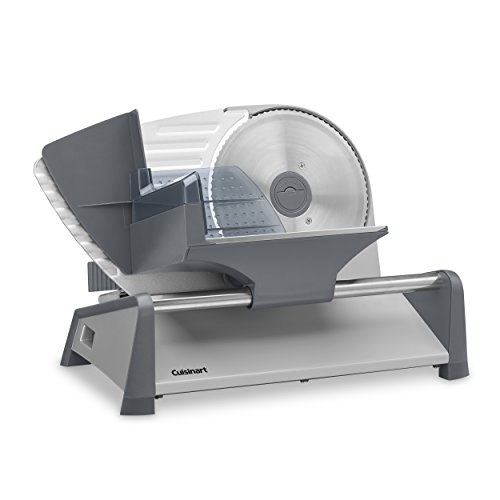
The FS-75 is a home food slicer with a removable 7.5-inch stainless-steel blade. Cuisinart's catalog title identifies a thickness adjustment from 1/32 to 1/2 inch and names bread, roasts and firm cheese. That range is useful for comparing intended slice styles, but it does not establish how cleanly a particular soft or sticky food will cut.
A slicer does not save money merely by sitting beside a larger package of meat. The financial case depends on what that package replaces, how much becomes usable food and whether your household eats it. A cheap whole cut that requires additional preparation is not automatically equivalent to the finished deli product you currently buy.
Instead of using a promised annual savings figure, build a small calculation from your own receipts. The examples below use invented round numbers to explain the arithmetic. They are not current food prices, appliance offers or a forecast of what you will save.
Compare like with like before using a calculator
Choose one food you buy repeatedly, such as cooked sandwich meat. Record the price and weight of the product you currently consume. Then find the cost of the alternative in the condition in which it will be sliced. If you intend to cook a raw roast, include the fact that cooking and trimming change its usable weight.
Comparing a pound of raw meat with a pound of ready-to-eat slices overstates savings whenever their usable yields differ. It can also ignore seasonings, cooking energy and packaging. You do not need laboratory precision, but you do need matching units and a complete enough comparison to avoid a misleading result.
Quality is another variable. If you are choosing a different cut, recipe or product because you prefer it, call that a preference. There is nothing wrong with spending more for control over what you prepare. Just do not label every improvement in the meal as a reduction in cost.
The three equations
Alternative food cost per usable pound = total food preparation cost ÷ usable pounds produced.
Net savings per usable pound = current comparable cost per pound − alternative cost per usable pound − additional variable slicing costs per pound.
Break-even pounds = appliance and setup cost ÷ net savings per usable pound.
The last equation is meaningful only if the savings number is positive. If the alternative costs more per usable pound, there is no purchase-price payback from that food alone. You might still want the slicer for slice thickness, recipe control or enjoyment, but that is a different justification.
Convert the result into time by dividing break-even pounds by the quantity your household will realistically slice and eat each week. Use normal consumption, not the amount you hope to prepare once the new appliance arrives. A machine cannot generate savings on food that stays unused.
A worked example with explicit assumptions
Imagine a household considering a slicer and necessary setup costing $300 in total. Its current comparable food costs $10 per pound. A prepared whole-food alternative costs $6 per usable pound after accounting for its actual yield. Additional variable costs are estimated at $0.50 per pound.
Input
Illustrative value
Calculation
Current food
$10.00 per usable pound
From hypothetical receipt
Alternative food
$6.00 per usable pound
After preparation and yield
Extra variable costs
$0.50 per pound
Hypothetical supplies and operation
Net saving
$3.50 per pound
10 − 6 − 0.50
Break-even quantity
About 86 pounds
300 ÷ 3.50
At 2 pounds each week
About 43 weeks
85.7 ÷ 2
That result is conditional. It assumes the household continues buying the same quantities, the estimated yield is correct, no significant additional repair cost occurs during payback and the food is actually used. It also leaves personal labor out of the cash calculation so that you can consider it separately.
Yield can change the answer more than a discount
Suppose an alternative costs $24 for four pounds before preparation. Dividing $24 by four gives $6 per purchased pound. If the usable result is only three pounds, the relevant cost becomes $8 per usable pound before other costs. Those two answers produce very different break-even estimates.
Use your own measured output from a representative preparation rather than a generic yield percentage. Different cuts and recipes behave differently. Count only food that serves the purpose you are comparing. Trimmings used elsewhere may have value, but do not assign that value twice.
If you routinely use end pieces in another meal, note that benefit as a separate credit with a defensible amount. If they are discarded, include the loss. The calculation should describe your kitchen rather than the most favorable possible kitchen.
Run a slow-use case, not just the optimistic case
Keep the same $300 setup and $3.50 net saving from the illustrative example. At one pound a week, payback becomes roughly 86 weeks. At three pounds, it is about 29 weeks. The appliance has not changed; only actual usage has.
Now test a smaller saving. At $1.50 per pound and two pounds a week, the same setup needs about 100 weeks to recover its cost. This sensitivity check tells you whether the decision relies on a narrow price difference that could disappear or on a habit you might not maintain.
A practical shopping rule is to be comfortable with the slower case. If the purchase only feels worthwhile under your most enthusiastic assumptions, wait until you have several weeks of receipts and a clearer routine. There is no penalty for discovering that the idea is appealing but the economics are weak.
Give cleaning time its own line
Personal time can be handled in two ways. For a cash-only estimate, leave labor out but state that you are doing so. For a personal-value estimate, assign your own value to the extra time and subtract it. Neither approach should hide the existence of the work.
Imagine ten additional minutes per session, once a week. At a self-selected value of $15 per hour, that time represents $2.50 per week. This is another hypothetical assumption, not a claim about how long a particular model takes to clean or what your time should be worth.
Some people enjoy the preparation and consider the time part of a hobby. Others want the fastest route to packed lunches. Your preference affects whether the same cash saving is attractive. Include setup, cleanup and returning the machine to storage, not only the moments when it is cutting.
Count the space commitment
Space has no universal dollar value, but it can still change the decision. A slicer that stays on the counter displaces another task or appliance. A slicer stored elsewhere creates a carrying routine. If that inconvenience reduces usage, it indirectly lengthens payback.
Before upgrading the budget to obtain a larger machine, complete the counter-space exercise. A machine that is technically more capable but used less often can be a worse investment. The smallest appropriate option may offer better real-world value than the model with the most ambitious specifications.
Reasons to buy that are not savings
You may want control over thickness, the ability to prepare a favorite cut or the satisfaction of making sandwich meat at home. Those are legitimate reasons. Separate them from the spreadsheet so the purchase does not need an exaggerated financial story.
A slicer can also be a poor answer to an occasional carving problem. If your main use would be a holiday roast, compare an electric knife or an existing suitable knife first. Our tool comparison focuses on that difference in tasks.
Decide with actual purchase figures
The products below cover different levels of home-appliance commitment. Enter the current price of the exact candidate into your calculation; this guide deliberately avoids a fixed Amazon price. The manufacturer’s Cuisinart FS-75 page confirms a home-slicer option, but its direct-store price is not a substitute for an Amazon offer.
Choose from the home collection only after checking fit and food compatibility. Then write down one cash payback estimate, one slower-use estimate and your nonfinancial reason for buying. If all three make sense to you, the purchase has a much stronger foundation than a generic promise that slicing at home always pays.
Check the model against your decision
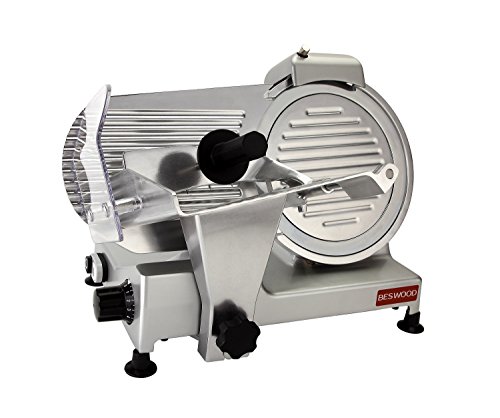
BESWOOD 250: Confirm the cutting envelope, assembled footprint, lifting weight, approved foods and cleaning procedure in the BESWOOD250 manual.
As an Amazon Associate, we may earn from qualifying purchases.
The BESWOOD250 occupies the step between a lightweight food slicer and a larger deli machine. Its listing identifies a 10-inch chromium-plated blade and 240W motor. The buying decision is whether that larger format earns its place on your counter through regular slicing, rather than whether a bigger blade looks more professional.