Choose a carriage slicer for repeated slices from food that fits its holder and documented cutting limits. Choose an electric knife for flexible carving on a board. The knife does not provide a slicer’s fixed thickness setting, while the slicer is a larger appliance with a more involved working area.
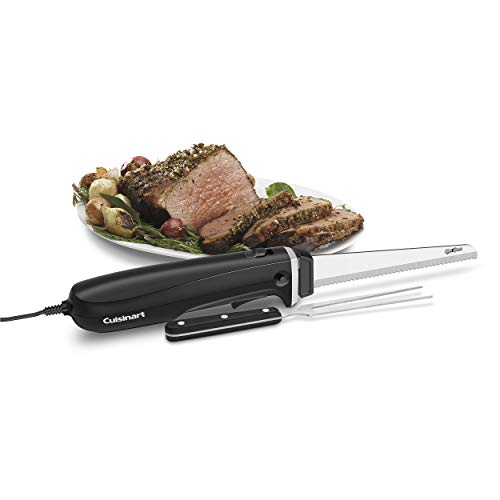
The CEK-41 is an electric carving-knife set with a bamboo board and serving fork. It appears here as an alternative for occasional carving, not as a meat-slicer model. A freehand electric knife answers a different need from repeatable carriage-guided slices.
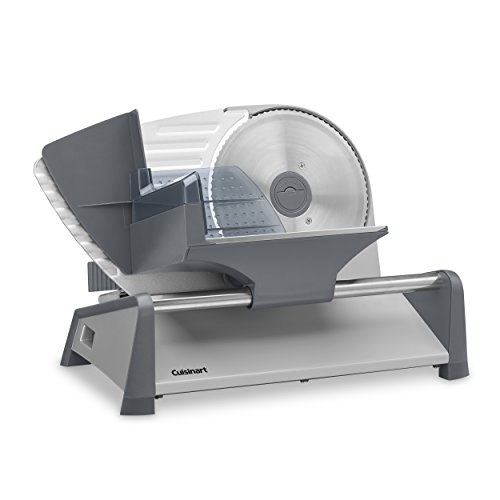
The FS-75 is a home food slicer with a removable 7.5-inch stainless-steel blade. Cuisinart's catalog title identifies a thickness adjustment from 1/32 to 1/2 inch and names bread, roasts and firm cheese. That range is useful for comparing intended slice styles, but it does not establish how cleanly a particular soft or sticky food will cut.
This CUSIMAX listing distinguishes itself with two removable 8.7-inch blades and a removable food carriage. It advertises a 1–20mm adjustment range. The practical question is whether the food-contact components you must wash can be removed in a way you are comfortable repeating after each session.
Cleaning is a different job, not just a different duration
What storage really means for each tool
Three households, three reasonable decisions
Choose by the job you repeat
If you mainly carve a roast for dinner, a meat slicer and an electric knife can look like two versions of the same purchase. Both use powered blades. In practice, the choice is about which part of the cutting task you want the tool to control.
A carriage slicer controls the food’s movement relative to a fixed cutting assembly and thickness setting. An electric knife remains a hand-guided carving tool. That difference affects the shape of the food you can handle, how repeatable the slices can be and how much setup is worthwhile for one meal.
The decision starts with the finished slice
Picture the result you want most often. Is it a stack of similarly thin slices for sandwiches, or individual portions carved from a roast on a board? The first task benefits from repeatable positioning. The second benefits from freedom to place and direct the blade around the shape of the food.
Neither tool removes the importance of food preparation or compatible use. A slice can tear because the food is unsuitable for the chosen method even when the appliance is functioning normally. “Powered” does not mean that a tool can cut any material or tolerate any food temperature.
Task
More natural starting point
What still needs checking
Repeated sandwich slices from a boneless piece
Carriage slicer
Food size, support and practical thickness
Occasional dinner carving on a board
Electric knife
Blade instructions and safe food control
Large pieces that do not fit a slicer carriage
A suitable carving method
Do not force oversized food into a machine
Weekly batch preparation
Evaluate a slicer
Operating limits and full cleanup time
Very limited appliance storage
Evaluate an electric knife first
Storage arrangement for handle and blades
Why a thickness dial changes the workflow
With a compatible food item secured correctly, a slicer gives you a reference setting for successive passes. You can inspect an initial slice and decide whether to adjust. The process is designed around repeating a similar movement rather than choosing a fresh cutting line by eye every time.
An electric knife assists the cutting motion, but you still choose the next slice’s position and angle. A practiced cook may produce attractive portions that way, yet the tool does not acquire a fixed thickness stop because its blade is powered. That distinction matters if consistency is the reason you are buying equipment.
For sandwiches, variation can change how slices stack and how many portions you obtain from a piece. For dinner carving, small differences may be unimportant. Avoid buying a dedicated slicer to solve a precision problem you do not actually have.
Carving around shape versus fitting the carriage
A roast on a board may be irregular. A handheld tool lets you choose your approach to that shape within its intended use. A slicer requires the food to fit and remain controlled throughout the carriage movement. If it is too large, a machine with an impressive blade diameter may still be unsuitable.
Dividing a piece before slicing is sometimes reasonable, but it changes the presentation and adds preparation. Think about whether that tradeoff matters. Small pieces for cooking have different requirements from long bacon strips or a full slice across the face of a roast.
Do not interpret this flexibility as permission to cut bone with an electric carving knife. Follow the exact knife instructions. Likewise, do not use a standard deli slicer as a workaround for food prohibited by its manual. Tool categories describe a general task, not unlimited cutting capability.
Compare two real Cuisinart formats
Cuisinart’s FS-75 is a home food slicer with a 7.5-inch blade and a slice-control knob. The CEK-41 is an electric knife set that includes a carving fork, board and storage tray. These official product descriptions illustrate the different formats; they are not evidence of a head-to-head performance test.
Use the FS-75 as a candidate when you want an appliance arranged around a sliding carriage. Use the CEK-41 as a candidate when you want a powered carving tool you guide on a board. Confirm that the exact Amazon offer matches the intended model and included set, particularly when pictures show accessories.
The CUSIMAX and BESWOOD candidates linked here provide alternative slicer formats for further comparison. Their presence does not imply that either has beaten the knife in a timed test. The question is whether their food-handling arrangement answers your recurring task.
Setup matters when you need only six slices
A tool can be faster during the cut but slower across the whole session. To compare fairly, include retrieving it, preparing its workspace, assembling permitted components, slicing, cleaning and putting it away. For a small quantity, those surrounding steps can dominate.
Consider a hypothetical Sunday dinner where you carve once and serve immediately. A suitable carving tool may fit the existing board-and-platter routine without adding another workstation. Now consider preparing several days of sandwich portions: the repeated task may justify a dedicated slicer arrangement.
There is no universal quantity at which one tool wins. Your storage location, food choices and willingness to clean equipment determine the crossover. If you already own a suitable electric knife, observe what specifically frustrates you before replacing it with a slicer.
Cleaning is a different job, not just a different duration
The slicer introduces a carriage, food holder and surfaces around a circular blade. The electric knife introduces a handle and removable cutting components according to its design. Compare the actual instructions rather than assuming “removable” means “dishwasher-safe” for either category.
Cuisinart describes a blade-release arrangement and blade cleanup for the CEK-41. The precise care directions still belong to that model’s manual. They do not authorize immersing a powered handle or treating another manufacturer’s blade the same way.
If you dislike dismantling appliances, inspect the slicer’s cleanup instructions before buying. If you dislike handling loose knife blades, inspect the electric knife’s release and storage procedure. The easier choice is the one whose required steps you can perform reliably, not the one a generic review calls effortless.
What storage really means for each tool
A slicer needs a location for an assembled machine or a manufacturer-approved storage arrangement. A knife set needs protected storage for its components. Count the actual case or tray size instead of comparing only the blade or handle.
For the slicer, evaluate the route from the shelf to the counter. For the knife, make sure the blades will not be loose in a drawer where someone can encounter them unexpectedly. The physical burden differs, but both purchases need a plan after the meal is finished.
The counter-space guide is useful if your preferred slicer would live on a crowded worktop. If the space commitment feels disproportionate to occasional use, that is a strong reason to stay with a suitable carving tool.
Three households, three reasonable decisions
The weekly sandwich household
This household regularly portions compatible boneless food and cares about consistent thickness. It should compare slicers by food capacity, permitted operating duration and access for cleaning. A knife can remain useful, but it is not the closest match to the repetitive task.
The occasional host
This household mainly wants assistance carving a dinner roast a few times a year. A suitable electric knife is worth examining before committing to a slicer. The deciding questions concern carving control, approved use and convenient storage, rather than a large carriage or commercial appearance.
The experimenter
This cook wants to try bacon, jerky and very thin meat dishes. Do not buy either tool on the assumption that it covers all three. Start with the food-state and dimensional requirements of the main project. A specialized manual tool may be relevant, but that is a different comparison.
Choose by the job you repeat
Write one sentence beginning “I need this tool because…” If the rest describes repeatable slices from food that fits, investigate the home slicer collection. If it describes occasional carving on a board, investigate the electric knife. If it describes only saving money, calculate actual usage and payback before buying either.
Check the model against your decision
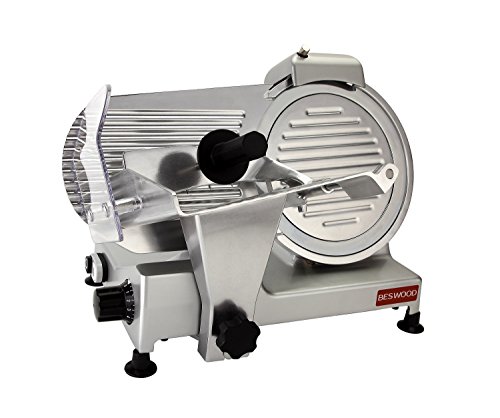
BESWOOD 250: Confirm the cutting envelope, assembled footprint, lifting weight, approved foods and cleaning procedure in the BESWOOD250 manual.
As an Amazon Associate, we may earn from qualifying purchases.
The BESWOOD250 occupies the step between a lightweight food slicer and a larger deli machine. Its listing identifies a 10-inch chromium-plated blade and 240W motor. The buying decision is whether that larger format earns its place on your counter through regular slicing, rather than whether a bigger blade looks more professional.