Choose a compact slicer by its measured working and storage footprint, not the smallest blade alone. First identify whether counter depth, cupboard height or lifting is your real constraint, then reject any small model that cannot hold the food you intend to slice.
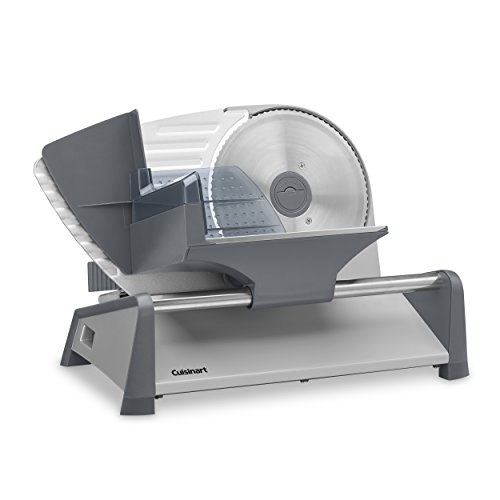
The FS-75 is a home food slicer with a removable 7.5-inch stainless-steel blade. Cuisinart's catalog title identifies a thickness adjustment from 1/32 to 1/2 inch and names bread, roasts and firm cheese. That range is useful for comparing intended slice styles, but it does not establish how cleanly a particular soft or sticky food will cut.
This VEVOR listing pairs a 7.5-inch electric slicer with two SUS420 blades. It is a relevant comparison against the brand's single-blade 7.5-inch offer: the useful difference is the supplied blade set, not an assumed jump in motor strength or slicing precision.
The NutriChef entry lists a 200W motor, removable 7.5-inch blade, food pusher and a 0–15mm thickness dial. Its compact-blade format belongs on a home-use shortlist where modest batches and post-use cleaning matter more than commercial throughput claims.
Four catalog candidates and the questions they raise
What a folding claim should mean before you rely on it
Prioritize access over squeezing into the last inch
When the compact option is the wrong compromise
“Compact” can describe three different things: a slicer that occupies little counter space, one that fits into a cupboard, or one that is easy to move. A product can satisfy one and disappoint on the other two. Before searching for the smallest meat slicer, decide which problem you are trying to solve.
This is a selection guide rather than a measured ranking of the smallest machines. The catalog candidates below offer home-slicer formats worth investigating, but a blade-size label does not establish their exterior dimensions. We have not performed a side-by-side footprint or cutting test.
Name the constraint that cannot change
If the counter is shallow, depth is likely your hardest limit. If you want to store the machine under a shelf, height and the cupboard opening matter more. If you must lift it from a low cabinet, weight and carrying access deserve priority. Writing down the constraint keeps you from choosing a model that is compact in the wrong direction.
Your constraint
Measure first
Do not rely on
Shallow counter
Full operating depth and carriage movement
Width in a front-facing photograph
Low shelf
Assembled height and insertion clearance
Height with parts removed for a photograph
Narrow cupboard door
Opening between hinges and frame
Internal shelf width alone
Frequent carrying
Actual weight and approved handling points
The word portable
Small cleanup area
Permitted part removal and drying arrangement
A vague easy-clean label
Set a maximum for the important measurement before looking at more products. That makes the shortlist faster. A machine outside the limit is not rescued by an attractive finish, an additional blade or a large advertised motor number.
A smaller machine still needs to fit the food
Imagine choosing the most convenient cabinet-sized model, then discovering that your usual roast must be divided several times to fit. That may be acceptable if you want small portions, but it defeats the purpose if you wanted complete slices. Establish the food requirement before making compactness the only criterion.
Measure your usual food in the orientation you intend to cut it. Look for documented cutting height and usable carriage space. If the manufacturer supplies only blade diameter, the necessary capacity information is incomplete. The blade-size worksheet explains what to ask for.
Do not solve a capacity mismatch by removing the food holder or improvising support outside the machine. Compact appliances are useful when the task fits their design. When it does not, a different preparation method or a larger suitable machine is the better decision.
Four catalog candidates and the questions they raise
Cuisinart FS-75: a documented home format
The FS-75 is a useful starting point because Cuisinart publishes dimensions and a manual for this exact home slicer. Its manufacturer dimensions are 9.25 by 14.5 by 10.5 inches. Transfer them to a paper plan in the correct orientation; do not assume the narrowest measurement is automatically the relevant counter depth.
Check the available movement space and the removal path for cleaning parts. The documented body dimensions help screen the model, but they do not answer every question about your particular cupboard or worktop. Confirm the selected offer is the FS-75 rather than relying on brand-level information.
VEVOR 7.5-inch two-blade listing: confirm the exact version
The catalog contains multiple VEVOR home-format listings. For this candidate, the listing identifies a 7.5-inch blade and two supplied blades. That helps distinguish the version, but it is not an exterior-size specification. Obtain the dimensions and manual for this exact listing before deciding it meets a small-space requirement.
Two blades can be useful only if their intended tasks match your menu and both can be stored appropriately. An unused accessory still needs protected space. Count the complete set, not merely the assembled machine shown in the main image.
Nutrichef 7.5-inch listing: check storage and controls
The Nutrichef catalog title identifies a 7.5-inch blade and an adjustable slicing range. For a small kitchen, the next questions are where the control sits, how the carriage extends and how the appliance is handled when put away. None is answered by the thickness range alone.
Look at the food holder and collection side as part of the layout. A machine that fits the shelf but blocks access to its controls on the counter would trade one inconvenience for another. Ask for the exact model documentation if it is not clearly linked from the offer.
CUSIMAX 8.7-inch listing: compare capacity against footprint
The CUSIMAX candidate describes an 8.7-inch blade, two removable blades and a removable carriage. It may be worth comparing when you need more food-handling room than another shortlisted design provides, but only actual capacity measurements can establish that advantage.
Do not dismiss it or prefer it simply because its blade is larger than 7.5 inches. Exterior proportions can differ between designs. Put its confirmed body and operating measurements on the same worksheet as the smaller-blade candidates and decide using your limiting dimension.
What a folding claim should mean before you rely on it
If you encounter a foldable model, identify exactly what folds and whether the manufacturer describes that position as storage-only. A folded photograph can make a device seem much smaller than its usable working arrangement. It does not reduce the room needed while slicing.
Also check what remains exposed and how the appliance is protected when stored. Folding should not mean loose sharp components placed casually in a crowded drawer. Ask whether attachments remain on the unit or must be stored separately, since the latter changes the real storage footprint.
No candidate in this guide earns a folding-space advantage without documentation for its exact model. A vague marketplace title is an invitation to investigate, not a measurement.
Prioritize access over squeezing into the last inch
A compact setup should be easy to retrieve and clean. If removing the slicer requires unpacking half a cupboard, you may use it less than planned. If the only available operating position forces awkward reaching, saving a few inches does not improve the kitchen.
Try a cardboard mock-up with empty food containers and your usual plate for finished slices. Open the adjacent cupboard doors. Move through the steps of retrieval and storage. This small exercise can expose a poor fit before you order an appliance that is difficult to return or repack.
For cleaning, inspect the part-removal instructions. A machine can be short enough to fit beneath a cabinet but need more clearance to remove a component. You might choose to move it before cleaning, but that means its weight and carrying routine become part of the purchase.
When the compact option is the wrong compromise
Choose a different approach if your normal food is oversized, your batches exceed the documented operating limits or you cannot provide a stable unobstructed workplace. Compactness is valuable only after those conditions are met. A small slicer that requires repeated workarounds is not a space-saving success.
If you carve only occasionally, a suitable electric knife may require less commitment. If you routinely slice larger quantities, a permanent place for a suitable larger slicer may be more practical than repeatedly unpacking a small one. These are different uses, not a single ranking from cheap to premium.
Return to the home slicer collection with three numbers: maximum working footprint, maximum stored size and required food capacity. Pick the candidate that satisfies all three with a cleaning routine you accept. That is a more useful definition of compact than the smallest blade in the search results.
Check the model against your decision
CUSIMAX 8.7-inch two-blade slicer: Verify each blade's edge type, the model number on the current offer, duty cycle and approved cleaning method.
As an Amazon Associate, we may earn from qualifying purchases.
This CUSIMAX listing distinguishes itself with two removable 8.7-inch blades and a removable food carriage. It advertises a 1–20mm adjustment range. The practical question is whether the food-contact components you must wash can be removed in a way you are comfortable repeating after each session.