Write down your busiest slicing batch, food types and available labor before comparing machines. Require documented suitability for that workload, acceptable sanitation credentials and a practical service path. A commercial label alone proves none of these.
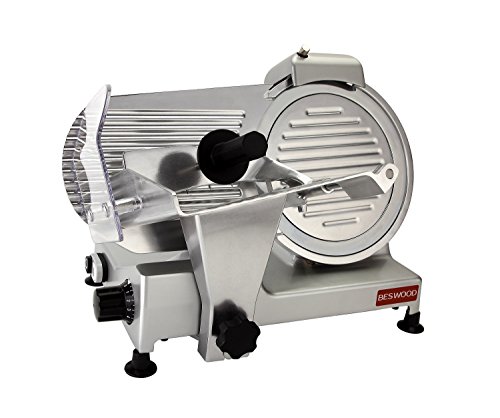
The BESWOOD250 occupies the step between a lightweight food slicer and a larger deli machine. Its listing identifies a 10-inch chromium-plated blade and 240W motor. The buying decision is whether that larger format earns its place on your counter through regular slicing, rather than whether a bigger blade looks more professional.
The VEVOR 10-inch 240W listing describes a chromium-plated blade and semi-automatic operation. It is a candidate for buyers comparing the larger circular-blade format with BESWOOD250, but similar dimensions in the title do not make their service support, carriage travel or permitted foods identical.
This 12-inch VEVOR listing advertises a 320W electric deli cutter. It belongs in a larger-machine comparison where the buyer has already measured product size and counter access. More blade diameter is useful only if the complete feed path accommodates the food you actually prepare.
Compare catalog candidates without turning claims into guarantees
Assess service before an emergency
Run a purchase rehearsal
A defensible final shortlist
Turn the shortlist into a scored decision
Agree on acceptance before placing the order
The expensive buying mistake is a slicer that fits the budget but not the shift. A machine can handle a demonstration ham beautifully yet become the bottleneck when several cheeses, roast beef and a queue of individual orders arrive together. The purchase decision starts with that mixed service period, not a photograph of the blade.
This guide is for a food business choosing equipment. Our commercial slicer collection provides product candidates; the process below explains how to qualify them. We have not performed a restaurant endurance test on these machines, and a catalog listing is not a health-department approval.
Write a one-page production brief
Ask the person doing the work to list the five foods sliced most often. Record the largest cross-section of each product, how it arrives, how thin customers request it and how many portions are prepared in the busiest hour. Separate cooked deli meats from raw ingredients. Include cheese as its own line even if it represents a small percentage of sales.
Then describe the longest uninterrupted run. Two businesses selling the same weekly weight can need different machines: one slices a modest amount each morning, while another cuts nearly all of it in a single catering preparation session. A daily total hides that difference. Our workload worksheet turns the brief into a schedule that a supplier can assess.
Brief item
What to record
Why it changes the choice
Food mix
Named meats, cheese types, raw or ready-to-eat status
Suitability and changeover requirements differ
Largest piece
Height, width and length at purchase
Carriage capacity can exclude a food despite a large blade
Peak batch
Saleable portions needed before a deadline
Sets practical capacity rather than a vague heavy-duty label
Staff availability
Who operates, portions and cleans
Determines whether powered carriage movement helps
Service tolerance
How long the menu can continue without slicing
Changes the value of parts and local repair
Use elimination gates before comparing features
Gate one: permission to use the equipment
Check the requirements of the authority responsible for your premises before ordering. Ask what sanitation and electrical documentation it requires for this equipment class. Obtain the exact model number and relevant listing information, then confirm that the documentation belongs to that model and configuration. A badge on a retailer page is a starting point for verification, not the end of it.
The FDA Food Code is a model offered for adoption by jurisdictions, so the applicable requirements are those adopted where the business operates. Do not assume that a product described as suitable for both home and commercial use satisfies every local equipment rule. FDA explains the model-code framework here.
Gate two: food and duration limits
Ask for the manual before purchase. Look for permitted foods, prohibited materials, operating intervals, rest requirements and any special limitations for cheese. If the manual does not answer your longest batch, send that specific batch description to the manufacturer. Silence is not evidence that continuous operation is allowed.
Electrical wattage does not supply the missing answer. It is not a measured rate of acceptable slices or a promise that a motor can tolerate a particular load indefinitely. Similarly, an advertised slice-thickness range says little about thickness consistency with the actual food you sell. Treat specifications as constraints, then seek evidence that the whole job fits within them.
Gate three: usable installation space
Measure the carriage at both travel extremes, the operator's standing position, the space for finished slices and the route for removing washable components. Include nearby doors, drawers and shelving. A machine that fits only while idle does not fit the station. Use the placement checklist before settling on a cabinet or worktable.
Choose the feeding system for the work pattern
Both manual-feed and automatic-carriage slicers can use an electric blade. The difference is whether an operator moves the carriage through each stroke. For short, varied orders, manually controlling the carriage may suit the workflow. For repeated batches of the same product, powered carriage movement may reduce repetitive work, provided its output and supervision requirements fit the station.
Do not equate a description such as electric, automatic or semi-auto with a particular carriage mechanism. Request confirmation or a demonstration of the exact model. Our carriage comparison distinguishes the motions and gives a labor calculation. There is no universal point at which every restaurant needs automation.
Make cleaning part of the buying demonstration
Ask the seller to show the approved breakdown procedure with the machine safely isolated from power. Identify which parts are removable, where they are washed, how the blade area is accessed and how guards are restored. The operator should be able to explain the sequence from the manual rather than improvise around difficult areas.
Time the whole process in a demonstration if one is available, including handling, washing, rinsing, sanitizing, drying and reassembly as specified. A claim that a carriage removes quickly is not a total sanitation time. Look at the actual sink space, drying space and component weight before counting that feature as a saving.
FDA's deli-slicer guidance highlights degraded seals and hard-to-clean areas as concerns. That makes access, inspection and replacement parts material purchasing issues, not cosmetic preferences. Read FDA's equipment guidance.
Compare catalog candidates without turning claims into guarantees
The manager-supplied catalog includes BESWOOD250, ASIN B01AQH636Q; a VEVOR 10-inch 240W listing, ASIN B08R7JJF3R; and a VEVOR 12-inch 320W listing, ASIN B0GSYXKNX9. Those identifiers distinguish three candidates. They do not establish comparable duty ratings, installation approvals or after-sale support.
BESWOOD's manufacturer page identifies a 10-inch BESWOOD250 and describes a manual gravity-feed design through its product information. Its stated dimensions and cutting envelope should be checked against the selected variant; the page also presents more than one blade size. A larger VEVOR listing merits a capacity question, not an automatic recommendation for a busier shop.
For each candidate, request the missing details in writing. Reject any comparison chart that quietly fills blank cells with assumptions borrowed from a similarly named model. In particular, do not treat 10-inch VEVOR listings with different wattages as interchangeable machines.
Assess service before an emergency
Find out who supplies the exact blade, sharpening components, food pusher, seals and wear parts. Ask whether diagnosis happens locally or requires shipping the machine. Get an estimate of how the process works rather than assuming a familiar brand name guarantees a nearby technician.
Consider the consequences of one failed component. If losing the slicer removes half the lunch menu, a documented repair route or backup production arrangement can matter more than a small purchase discount. If slicing is occasional and another approved preparation method is available, the same downtime may be tolerable. Value the service path according to your menu.
Run a purchase rehearsal
Imagine delivery tomorrow. Who receives the carton, checks damage, lifts the machine onto the station, records its serial number and trains the opening crew? Where will the manual live? Which person confirms that every guard is in place after cleaning? If these tasks have no owner, include them in the purchase plan rather than leaving them to the first busy morning.
Where a supervised product demonstration is possible, bring a representative permitted food and a written acceptance sheet. Evaluate saleable slices at your requested thickness, heel waste, practical portioning space and operator reach. Record the conditions; an easy test on a smaller product cannot validate a more demanding food or a longer run.
For an online purchase without a demonstration, reduce uncertainty with model documentation and clear return terms before ordering. Do not plan an unsafe trial outside the manufacturer's instructions to discover the machine's limits after delivery.
A defensible final shortlist
Keep only machines that pass approval, workload and placement checks. Then rank the survivors by cleaning practicality, service access, output control and total cost for the expected ownership period. A lower price can break a tie; it cannot rescue an unsuitable duty cycle or a missing guard.
For a small deli, the sensible choice may be a documented manual-feed machine whose limits comfortably cover the peak batch. For repetitive production, investigate a properly specified automatic-carriage model even if none of the current catalog candidates can yet be qualified for that role. The correct decision can be to request more evidence rather than award a best-overall label.
Turn the shortlist into a scored decision
Once every candidate has passed the mandatory gates, use a short scorecard for the remaining trade-offs. Give the greatest weight to the problems your business actually experiences. A restaurant with reliable morning preparation but frequent cleaning delays should not use the same weights as a deli whose main constraint is repetitive order fulfillment.
For an example, allocate 30 points to demonstrated workload fit, 25 to cleaning practicality, 20 to service access, 15 to station fit and 10 to purchase terms. These are illustrative weights, not an industry rating. Score only documented or observed evidence, and leave unresolved items blank. An unknown score must not silently become an average score.
Write one sentence explaining each score. For cleaning, the evidence might be that the removable carriage fits the existing washing facility and the approved procedure can be completed by trained staff. For service, it might be a named provider's written confirmation that the exact model is supported. This makes the comparison reviewable by someone who did not attend the sales demonstration.
Do not use the total to override a failed requirement. A machine cannot compensate for unsuitable electrical configuration by earning extra points for price. The weighted score applies only after all essential conditions have been met.
Agree on acceptance before placing the order
Define what will be checked when the machine arrives: exact identity, undamaged components, complete documentation, the agreed installation arrangement and the approved operating checks. Assign a person to resolve discrepancies with the seller before normal production begins. This is especially useful when purchasing and kitchen operations are handled by different people.
Retain the offer description and relevant correspondence with the equipment file. If the delivered variant differs, the record makes the issue concrete. A verbal promise that a machine should be fine for your shop is much harder to evaluate than a response to a dated workload brief.
Finally, schedule a short review after staff have used the equipment under its instructions. Look at actual batch completion, cleaning practicality and any unexpected handling problem. Early observations can identify a training issue or a mismatch while there is still an opportunity to address it through the applicable support process.
Check the model against your decision
VEVOR 12-inch 320W slicer: Confirm net weight, working footprint, feed capacity, protective devices and service arrangements.
As an Amazon Associate, we may earn from qualifying purchases.