Compare suitable machines over the same ownership period. Add installation, paid handling and cleaning time, maintenance, consumables and realistic downtime. Keep unknown costs visible and label scenario assumptions; the cheapest purchase is not necessarily the lowest-cost workflow.
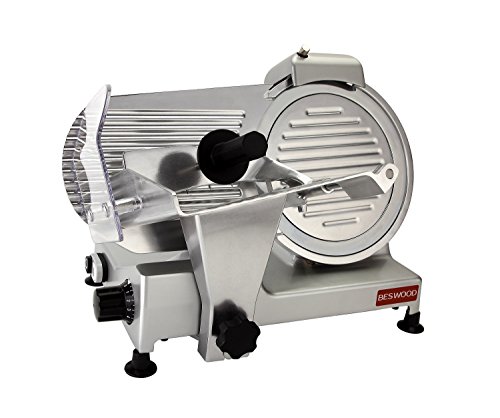
The BESWOOD250 occupies the step between a lightweight food slicer and a larger deli machine. Its listing identifies a 10-inch chromium-plated blade and 240W motor. The buying decision is whether that larger format earns its place on your counter through regular slicing, rather than whether a bigger blade looks more professional.
The VEVOR 10-inch 240W listing describes a chromium-plated blade and semi-automatic operation. It is a candidate for buyers comparing the larger circular-blade format with BESWOOD250, but similar dimensions in the title do not make their service support, carriage travel or permitted foods identical.
This 12-inch VEVOR listing advertises a 320W electric deli cutter. It belongs in a larger-machine comparison where the buyer has already measured product size and counter access. More blade diameter is useful only if the complete feed path accommodates the food you actually prepare.
Daily minutes can outweigh a modest price difference
Measure whole tasks before monetizing features
Estimate energy without overstating precision
Price maintenance as a service process
Model downtime without counting all sales as lost profit
Use the catalog as a quote checklist
Make the decision from a range
Record costs that do not change between candidates
The invoice is only one part of a slicer's cost. In a busy kitchen, small differences in daily handling or cleaning time can accumulate across hundreds of service days. In an occasional-use business, those same differences may be too small to justify a higher purchase price.
A useful cost comparison therefore starts with the business's actual schedule. This worksheet uses explicit example numbers to show the arithmetic. None of the dollar figures is a current product quotation, expected repair bill or guaranteed saving.
Use one period and one workload
Choose a comparison period, such as three years, and estimate the operating days within it. Apply the same production requirement to every candidate. Otherwise, a machine can appear cheaper simply because its comparison assumes fewer batches or less sanitation work.
Keep purchase cash flow separate from operating costs. If financing is involved, use the actual quoted terms and your own accounting approach. Do not mix a financed monthly payment for one machine with the full purchase price of another and call the results comparable.
Exclude machines that do not meet the required workload, placement and local equipment requirements before doing the calculation. An unsuitable product cannot become economical through a favorable spreadsheet.
The ownership equation
Ownership cost = acquisition + installation + labor + consumables + maintenance + downtime costs − any defensible residual value. Use residual value only when you have a reasonable basis; leaving it at zero is clearer than inventing a resale price.
Cost line
Input to collect
Common omission
Acquisition
Current machine quote, delivery and applicable charges
Freight or offer-condition differences
Installation
Support, electrical assessment and handling
Counter or table replacement
Labor
Observed minutes and loaded hourly cost
Cleaning, reassembly and portioning
Consumables
Approved cleaning materials and permitted supplies
Items used every service day
Maintenance
Documented service and exact parts quotations
Labor and transport alongside the part
Downtime
Backup method or lost contribution assumptions
Menu disruption beyond the repair invoice
Daily minutes can outweigh a modest price difference
Suppose two suitable machines differ by six minutes of total daily handling and cleaning time in a representative demonstration. At 250 operating days per year, that is 1,500 minutes, or 25 hours. Using an illustrative loaded labor cost of $24 per hour gives $600 of annual task-time value.
Over three years the undiscounted value is $1,800, provided the time difference persists. This does not automatically mean payroll falls by $1,800. The freed time might be used for other preparation, reduce overtime or simply relieve a bottleneck. State which benefit is realistic for the business.
Do not count the same minutes twice. If a demonstration's cleaning time already includes component removal and reassembly, do not add those tasks again. If two workers are involved, distinguish elapsed machine downtime from total paid labor time.
Measure whole tasks before monetizing features
A removable carriage may save handling time, but that needs to be observed within the approved process. A powered carriage may reduce repetitive movement while leaving loading and portioning unchanged. Features are not savings until their effect on the entire task is understood.
Use the carriage comparison to identify which work is automated. Then record a base case and a conservative case. If the higher-priced option works financially only under the most optimistic labor assumption, the decision deserves closer scrutiny.
Keep food yield separate from labor. If you believe one machine reduces rejected slices or unusable heels, obtain a representative test and record the input and saleable output. Do not assign a yield saving from blade size or marketing language alone.
Estimate energy without overstating precision
A simple planning estimate is rated watts divided by 1,000, multiplied by operating hours and the electricity tariff. For example, 240 watts multiplied by two hours gives 0.48 kilowatt-hours before applying a rate. This is arithmetic using an assumed duration, not a measured consumption result.
Actual consumption can differ with load and operating conditions. Use metered data if energy materially affects the decision, and do not confuse nameplate input with mechanical output. In many modest-use scenarios, the uncertainty in labor minutes can matter more than the precision of this energy estimate.
A larger wattage number can increase an estimated input line without proving faster production. If it shortens the actual job, the duration changes too. Both variables must be measured or clearly assumed before comparing energy per completed batch.
Price maintenance as a service process
Ask for the model's maintenance requirements and quotations for likely wear components. Include the approved part, labor, travel or shipping and expected turnaround. A blade price alone is not a complete repair cost if installation or adjustment needs professional service.
Do not manufacture a yearly replacement schedule when the manufacturer specifies condition-based service or another interval. Record the requirement as documented, then build scenarios where actual wear is uncertain. This keeps a cost model honest without pretending that unknowns do not exist.
FDA's guidance emphasizes maintaining seals and using appropriate repairs for sanitation defects. A low-cost improvised repair is not an equivalent alternative to restoring the equipment correctly. FDA's slicer maintenance guidance explains why equipment condition belongs in this budget.
Model downtime without counting all sales as lost profit
If the slicer fails, can the menu continue with a permitted substitute process or purchased sliced ingredients? Estimate the extra cost of that arrangement. If some sales truly disappear, distinguish sales revenue from the contribution the business would have retained after associated costs.
For a scenario, suppose backup ingredients cost an additional $45 per service day for three days. The temporary ingredient premium is $135. Add actual additional labor or transport where applicable, but avoid adding a full lost-sales figure for orders still served through that backup.
Keep at least two scenarios: a short disruption with a workable backup and a longer disruption that exposes the operation. These are planning cases, not predictions of product reliability. No failure rate has been measured for the catalog machines here.
Use the catalog as a quote checklist
For BESWOOD250, VEVOR B08R7JJF3R and VEVOR B0GSYXKNX9, collect current offer details and model-specific support information. The manager's catalog identifies candidates but does not provide a complete ownership-cost record. The commercial collection links those candidates to the relevant decision guides.
If considering used equipment, substitute inspected ready-to-use cost for acquisition alone. The used-versus-new guide explains how inspection and initial repairs can change the comparison.
Make the decision from a range
Run a conservative, expected and demanding workload case with the same assumptions for each suitable machine. Identify which variable changes the ranking: labor, service access, acquisition or downtime. That is the variable worth investigating further before purchase.
Choose the machine whose advantages survive realistic assumptions, and retain the worksheet. After several months, replace estimates with actual minutes and invoices. The model then becomes a useful replacement-planning tool rather than a one-time justification for a purchase already chosen.
Record costs that do not change between candidates
Some costs will be identical, such as a sanitation task required regardless of the selected machine. Keep them visible in the total budget, but do not let them create a false distinction in the comparison. The incremental decision depends on costs and benefits that actually differ.
It can help to show two columns: total ownership budget and additional cost relative to the least expensive suitable option. The first supports cash planning; the second shows what the premium must deliver. Both should use the same time period and the same workload assumptions.
Check the model against your decision
VEVOR 12-inch 320W slicer: Confirm net weight, working footprint, feed capacity, protective devices and service arrangements.
As an Amazon Associate, we may earn from qualifying purchases.