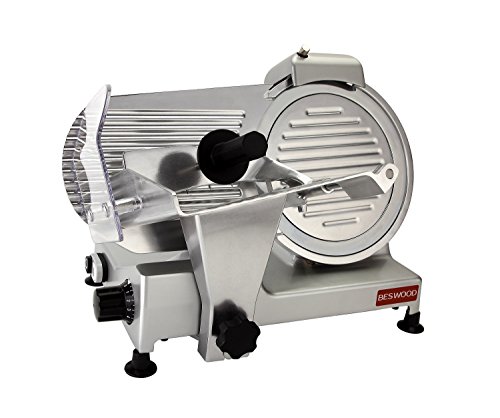
An electric blade does not mean the carriage moves automatically. Manual-feed machines require each carriage stroke; automatic-carriage machines power that travel. Choose according to repetitive batch work, supervision and portion handling, not the word automatic in a listing.
The BESWOOD250 occupies the step between a lightweight food slicer and a larger deli machine. Its listing identifies a 10-inch chromium-plated blade and 240W motor. The buying decision is whether that larger format earns its place on your counter through regular slicing, rather than whether a bigger blade looks more professional.
The VEVOR 10-inch 240W listing describes a chromium-plated blade and semi-automatic operation. It is a candidate for buyers comparing the larger circular-blade format with BESWOOD250, but similar dimensions in the title do not make their service support, carriage travel or permitted foods identical.
This 12-inch VEVOR listing advertises a 320W electric deli cutter. It belongs in a larger-machine comparison where the buyer has already measured product size and counter access. More blade diameter is useful only if the complete feed path accommodates the food you actually prepare.
A restaurant can buy an electric slicer and still spend the entire preparation session moving its carriage. That is normal for a manual-feed design. Confusion starts when a retailer uses automatic to mean that the blade spins under power, while the buyer expects the tray to travel by itself.
The most useful comparison separates three jobs: moving the food through the cut, controlling the thickness and collecting or portioning the slices. Automating one job does not necessarily automate the other two. Before paying for a feature, identify which job actually slows your station.
Trace one slice from loading to portioning
The operator places an approved food on the carriage and secures it using the prescribed holder.
The thickness control sets the relationship between food support and blade.
Carriage travel moves the food through the cutting zone.
The slice reaches the receiving area, where it may need collecting, weighing or arranging.
The remaining food returns for the next pass until the batch is complete.
In a manual-feed machine, the operator supplies the carriage travel. In an automatic-carriage design, a mechanism supplies that repeated movement. Specific machines may offer additional controls, but those must be verified individually. Neither term alone promises stacking, weighing, hands-free loading or unattended operation.
A model described as semi-automatic deserves a precise question: which of those five steps is powered? Ask to see the carriage moving in the documented operating mode. Product videos that show only a rotating blade cannot resolve the distinction.
The order queue tells you more than daily pounds
Imagine a deli where every order requests a different meat and thickness. The operator frequently changes products, adjusts the setting and portions a small amount. Powered carriage travel could still help, but the available saving is limited by those interruptions. Manual control may integrate well with that varied work.
Now imagine preparing a large run of the same ingredient for boxed lunches. Repeated strokes dominate a longer portion of the job. Carriage automation becomes a more relevant feature, although finished slices still need handling and the machine still needs the supervision required by its manual.
Observed work
Question to ask
What would support automation
Many tiny custom orders
Is loading or slicing the bottleneck?
Measured travel-time savings exceed frequent setup time
Long repeat batches
How much of the batch is repetitive carriage movement?
Substantial supervised repetitive work is removed
Frequent weighing
Does portioning keep pace with the slicer?
The receiving process can use the extra output
Limited station space
Does powered travel remain within a protected operating envelope?
Placement supports the full motion without obstruction
Calculate the saving without inventing a speed
Use observed task times from a lawful, supervised demonstration or your existing process. Do not take a strokes-per-minute claim and call it meals-per-hour. A slice that needs rework, falls into an unsuitable area or misses a portion target is not useful throughput.
Here is an illustrative calculation, not a performance claim for any product. Suppose a repeated batch takes 18 minutes of manual carriage operation, plus 7 minutes of loading and portioning. If a suitable automatic-carriage machine reduces attended carriage work to 8 minutes while the other work remains 7 minutes, the potential labor difference is 10 minutes per batch.
At six identical batches per day, that is 60 minutes of task time. But the result is a real staffing saving only if the employee can productively use those intervals while satisfying supervision and safety requirements. Fragmented minutes may improve comfort or service responsiveness without eliminating a paid hour.
Make a second calculation for the entire station: loading, cutting, arranging, weighing, labeling, changeovers and sanitation. If those total times barely change, automation has improved one motion rather than solved the production constraint. That can still have value, but the justification is different.
Where the operator's judgment stays essential
A powered carriage cannot decide whether the food is suitable, whether a guard was correctly restored or whether an abnormal sound requires a stop. Staff still need to recognize damaged product holders, poor positioning and emerging faults. The approved operating procedure must explain these responsibilities for the exact equipment.
Do not plan for a person to reach into the receiving path during motion unless the manufacturer explicitly describes a safe operating method. Likewise, do not assume that an automatic cycle can be left running while the operator goes into another room. A convenience feature does not replace the machine's supervision instructions.
Training should include stopping and safely isolating the equipment, restoring all components after cleaning and identifying who can perform servicing. A second operating mode introduces another task to learn, not a reason to reduce training.
What our current catalog can establish
The BESWOOD250 listing, ASIN B01AQH636Q, is a relevant manual-feed candidate; BESWOOD describes its gravity-feed slicer on its manufacturer website. The VEVOR 10-inch listing B08R7JJF3R uses semi-auto language. That wording should not be translated into powered carriage travel without its exact manual.
The VEVOR 12-inch B0GSYXKNX9 is another size to investigate, but its catalog title supplies no verified automatic-carriage specification. These products can be compared in the commercial equipment collection; they are not presented here as a verified choice for every automation requirement.
Manufacturer industry pages, including Hobart's slicer overview, illustrate that commercial equipment is divided into different machine families and functions. That context does not make those additional machines part of our Amazon catalog or establish specifications for the products above.
Questions for a meaningful demonstration
Ask the demonstrator to use a representative food, the intended slice thickness and the normal receiving container. Record the batch weight at the start and the saleable output at the end. Include the time needed to collect and portion the slices so that a fast blade does not hide a slow downstream process.
Observe the final section of the food, too. Some trials show only the easiest middle portion and skip the awkward heel. Keep normal holders and guards in place throughout. If a demonstration requires removing protection to achieve the claimed output, it does not prove the machine fits your task.
After the cutting trial, review cleaning and mode changes. Can staff clearly tell which mode is selected? Are controls within comfortable reach from the actual station position? Can the machine be returned to its prescribed safe state before disassembly? Note these answers alongside output measurements.
Decide what you are buying
Choose manual feed when short, variable work fits available staffing and the machine is documented for the load. Investigate automatic carriage when repeated travel is a substantial, measured part of the workload and the whole station can benefit. Either choice still needs suitable food capacity and a workable cleaning schedule.
Before deciding, use the peak-demand worksheet and the ownership-cost model. The first confirms what work must be done; the second tests whether the proposed labor saving can reasonably pay for the extra equipment and service. The purchase should solve a documented problem, not an ambiguous label.
Check whether a trial reflects normal staffing
A supplier may demonstrate a machine with one person loading, another collecting slices and a third explaining the controls. Your kitchen may assign only one person to that station. Repeat the time analysis using the staffing you will actually provide. Otherwise, the demonstration measures a production team you do not have.
Also test the decision against a quiet shift. A feature that helps a long batch may add setup without meaningful benefit on short orders. Record both patterns so the purchase reflects the full week rather than only its busiest hour.
Check the model against your decision
VEVOR 12-inch 320W slicer: Confirm net weight, working footprint, feed capacity, protective devices and service arrangements.
As an Amazon Associate, we may earn from qualifying purchases.