Size the job around the busiest required batch and its deadline. Add loading, portioning, changeovers, sanitation and manufacturer-required rest periods. Daily pounds and motor watts alone cannot show whether a slicer will keep up.
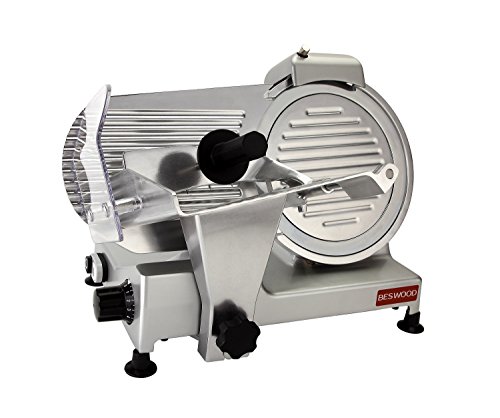
The BESWOOD250 occupies the step between a lightweight food slicer and a larger deli machine. Its listing identifies a 10-inch chromium-plated blade and 240W motor. The buying decision is whether that larger format earns its place on your counter through regular slicing, rather than whether a bigger blade looks more professional.
The VEVOR 10-inch 240W listing describes a chromium-plated blade and semi-automatic operation. It is a candidate for buyers comparing the larger circular-blade format with BESWOOD250, but similar dimensions in the title do not make their service support, carriage travel or permitted foods identical.
This 12-inch VEVOR listing advertises a 320W electric deli cutter. It belongs in a larger-machine comparison where the buyer has already measured product size and counter access. More blade diameter is useful only if the complete feed path accommodates the food you actually prepare.
Reserve capacity should reflect your own variation
Compare size only after the schedule is clear
Build sanitation into the schedule at the start
Review after a real week of service
Keep a separate exception plan
Your busiest 45 minutes can decide whether a slicer is adequate, even if it sits idle for much of the day. A café preparing ingredients before opening has a deadline. A deli slicing to order has a queue. A caterer has a batch that must finish before packing begins. These are different capacity problems.
The following worksheet is an original planning method, not a laboratory rating system. It helps you describe demand to a manufacturer and identify missing data. It cannot turn an undocumented machine into a continuous-duty model.
Start with the production deadline
Choose a representative busy day and divide it into actual work windows. Record when slicing can start and when the finished portions are needed. Do not count time when the operator is assigned elsewhere or when the station is unavailable. The resulting window is the capacity you truly have.
Next, count the saleable output required inside each window. Portions are often more useful than raw weight because waste, thickness and portioning affect what the kitchen can serve. Keep weight too, but do not compare different foods as if a pound of each required the same effort.
Window
Food and output
Operator available?
Deadline constraint
Opening preparation
Write actual portions by ingredient
Subtract receiving and setup duties
First service begins
Lunch replenishment
Record largest realistic refill
Allow for customer orders
Prepared stock runs out
Catering run
Record one complete large batch
Identify dedicated staff
Packing or dispatch begins
Separate cutting time from station time
Use a stopwatch during your current approved process or a supervised demonstration. Start timing before loading and stop after finished portions are ready for their next step. Then break the total into loading, slicing, receiving, weighing, packaging and changeover. This reveals whether the blade is actually the limiting resource.
If two people work together, record both elapsed minutes and labor minutes. A ten-minute job with two staff consumes twenty labor minutes but occupies the station for ten. Buying a faster machine may improve one measure more than the other. Be explicit about which problem you want to solve.
Include rejected slices and heel waste in the record. A higher nominal stroke rate can be misleading if it produces more rework. For meaningful comparisons, use the same food form, target thickness and acceptable finished result.
A worked schedule with declared assumptions
Suppose a shop has a 60-minute preparation window. Its observed process needs 8 minutes for setup, 24 minutes of cutting, 10 minutes for portioning and 12 minutes for an applicable cleaning and reassembly task. Total station time is 54 minutes, leaving 6 minutes for interruption. These values are fictional examples; measure your own times.
If a larger order increases cutting from 24 to 36 minutes, the same process now requires 66 minutes. The problem is not solved by saying the machine operates only a few hours per day. It misses this particular deadline. Options include changing the permitted schedule, adding documented suitable capacity or redesigning portion handling.
Now suppose the candidate machine's manual requires a rest period during that run. Add that interval to elapsed time. Do not subtract it because the employee can perform another task: the station still cannot deliver slices while the machine is resting. The distinction matters when food must be ready at one fixed time.
Ask the manufacturer a question it can answer
Instead of asking whether a slicer is heavy duty, describe the longest run, foods, target thickness and expected changeovers. Ask whether the exact model is suitable under its written operating instructions and what rest intervals apply. Keep the response with the purchasing records.
For cheese, name the cheese and block dimensions rather than saying occasional cheese. A brief but demanding cheese batch may matter more than its percentage of daily sales. If the supplier provides only a general marketing sentence, the workload question remains unresolved.
Do not infer duty cycle from a thermal cutout. A protective stop is not a normal scheduling feature or permission to repeatedly run equipment until it stops. If the machine slows markedly, trips protection or produces abnormal heat, stop according to its instructions and have the cause assessed.
Reserve capacity should reflect your own variation
A fixed percentage of spare capacity sounds tidy but can be arbitrary. Use your busiest observed days to estimate variation. If the largest legitimate order is substantially above the average, design around that order or have an explicit overflow plan. If the menu is predictable, a smaller reserve may be adequate.
Track late deliveries, staff absence and cleaning interruptions separately from actual slicing demand. These events affect the available window. Buying a larger blade will not compensate for a sink that is occupied when the slicer must be cleaned or a trained operator who is unavailable.
For a new business without records, use menu and order assumptions openly. Create a base case, a busy case and a large-order case. Avoid presenting these forecasts as proven demand. Revisit them after opening with actual production data.
Compare size only after the schedule is clear
The current catalog offers a BESWOOD250 10-inch listing, a VEVOR 10-inch 240W listing and a VEVOR 12-inch 320W listing. They provide different candidate descriptions, not verified comparative throughput. Product titles do not establish that the larger blade finishes your schedule faster.
A wider food may require a different cutting envelope even when weight is modest. Conversely, a small-diameter product may fit a smaller machine yet require many strokes because the target portion is thin. Treat physical fit and time capacity as separate checks within the commercial slicer shortlist.
The carriage-type guide helps when repeated manual strokes dominate the measured task. If portioning dominates instead, investigate that process before paying for automated travel.
Build sanitation into the schedule at the start
Schedule the applicable cleaning events as fixed work, then fit production around them. Our cleaning-frequency guide explains the FDA recommendation and the role of local requirements. A production plan that works only by delaying sanitation is not a workable capacity plan.
Assign each event an owner and an available station. If different people slice and clean, include the handover. If disassembled components need drying space, ensure it is free. These practical dependencies should appear on the same schedule as the food batches.
Review after a real week of service
Record three measures: missed deadlines, actual operator time and discarded or reworked output. Add notes for unusual orders, food condition and any machine faults. This separates a persistent capacity shortfall from a temporary staffing or ingredient problem.
If deadlines are missed despite compliant operation and an efficient receiving process, take the records back to the supplier. If the station finishes on time but staff spend most of the job weighing and packing, a different machine may not deliver the expected benefit. The decision should follow the observed constraint.
Keep this workload record with your purchase brief. It gives a future replacement decision a factual starting point and prevents the next buyer from inheriting an unsupported claim that the existing machine has always been large enough.
Keep a separate exception plan
A rare order beyond normal capacity should trigger an agreed response: earlier permitted preparation, a suitable additional station or a change to the order commitment. It should not trigger operation outside the manual. Write down who can accept an unusually large order and what capacity information they must check first.
This gives sales and kitchen staff the same boundary. Without it, a technically suitable machine can appear inadequate simply because the business promises an unplanned volume with no additional production window.
Check the model against your decision
VEVOR 12-inch 320W slicer: Confirm net weight, working footprint, feed capacity, protective devices and service arrangements.
As an Amazon Associate, we may earn from qualifying purchases.