FDA recommends cleaning and sanitizing commercial deli slicers according to the manufacturer’s instructions at least every four hours. Earlier cleaning can be necessary after contamination or relevant food changes. Follow your jurisdiction’s adopted rules and the exact equipment procedure; a quick wipe does not count.
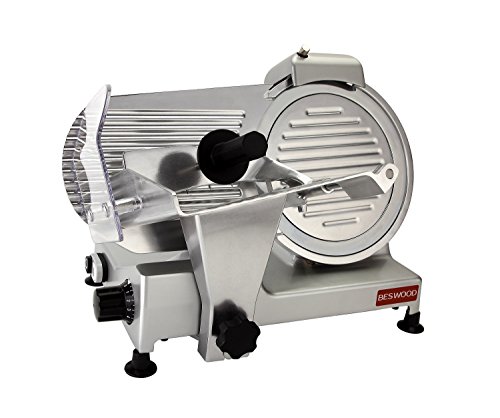
The BESWOOD250 occupies the step between a lightweight food slicer and a larger deli machine. Its listing identifies a 10-inch chromium-plated blade and 240W motor. The buying decision is whether that larger format earns its place on your counter through regular slicing, rather than whether a bigger blade looks more professional.
The VEVOR 10-inch 240W listing describes a chromium-plated blade and semi-automatic operation. It is a candidate for buyers comparing the larger circular-blade format with BESWOOD250, but similar dimensions in the title do not make their service support, carriage travel or permitted foods identical.
This 12-inch VEVOR listing advertises a 320W electric deli cutter. It belongs in a larger-machine comparison where the buyer has already measured product size and counter access. More blade diameter is useful only if the complete feed path accommodates the food you actually prepare.
The interval is a ceiling, not a promise that nothing else matters
Use one record that follows the machine
An example of scheduling around service
Food changes require a separate decision
Why a wipe does not reset the record
A defect changes the answer from clean to remove from use
Build accountability without creating a blame exercise
What to look for when replacing the slicer
Handle interruptions explicitly
A cleaning schedule fails when everyone knows the slicer was wiped but nobody knows when it was last fully cleaned and sanitized. The distinction matters. Removing visible scraps does not establish that the equipment has received the required sanitation procedure.
FDA's commercial deli slicer guidance recommends the manufacturer's cleaning and sanitizing procedure at least once every four hours. This page explains how to turn that recommendation into a usable shift schedule. It does not replace local rules or your machine's disassembly instructions.
The interval is a ceiling, not a promise that nothing else matters
Waiting for a scheduled time is inappropriate when contamination or an equipment defect is discovered. The schedule should therefore have two types of triggers: time-based tasks and event-based tasks. Put both in the written station procedure so that staff do not interpret the clock as permission to ignore an earlier problem.
For legal requirements, consult the authority responsible for your establishment and the code it has adopted. The FDA Food Code is a model for jurisdictions, not a claim that identical wording has automatically become law everywhere. Do not create an exception based on an online summary when the local regulator has not confirmed it applies.
Use one record that follows the machine
Place the sanitation record at the station or in the system used by its operators. Record completion of the full process, who performed it, any defect found and the next scheduled task under the establishment's procedure. A handover should transfer that information rather than reset the clock because a new employee has arrived.
Record field
Useful entry
Entry that leaves uncertainty
Completed task
Full model-specific cleaning and sanitizing procedure completed
Wiped slicer
Time
Actual completion time
Morning
Responsibility
Named trained operator
Kitchen team
Condition
Inspection result and any service action
Looks fine
Next action
Scheduled task and responsible person
Clean later
The record should be simple enough to complete during service. A complicated form that staff abandon is less useful than a short, consistently completed log. However, simplifying the paperwork must not shorten the actual cleaning procedure.
An example of scheduling around service
Consider a shop planning slicing from 8 a.m. into the afternoon. It should reserve a sanitation window before the applicable interval is exceeded, with earlier intervention when required. If the lunch rush would collide with that window, schedule the work earlier or arrange another compliant production method. Do not simply move the task to the end of service.
The exact start point, event rules and any applicable exceptions should be defined in the establishment's approved procedure. A timer can remind staff, but the person in charge must ensure the interpretation matches local requirements. This avoids turning an illustrative schedule into an unsupported regulatory rule.
Account for the time the slicer is unavailable, including approved disassembly, cleaning, rinsing, sanitizing, drying and reassembly. The overall window may be longer than the hands-on portion. Planning only a few moments to spray a surface does not reserve enough capacity for the actual job.
Food changes require a separate decision
A station moving between raw ingredients and ready-to-eat foods needs a procedure that prevents cross-contamination. Milk-containing cheese also raises allergen cross-contact questions when the next food is intended for someone avoiding milk. A normal product change and a sanitation-critical change should not be treated as the same event.
Have the person responsible for food safety define the required action for the products and claims your business handles. Do not promise an allergen-free serving because staff wiped the blade or because the next product contains no milk itself. Shared equipment and the entire food path matter.
Where separate equipment is used for different tasks, keep that assignment clear. Separation can simplify workflow, but it does not remove cleaning obligations for either machine. Labeling and staff training should prevent the backup slicer from being borrowed casually for an incompatible job.
Why a wipe does not reset the record
A visible wipe can remove loose food while leaving deposits under components or in seams. The complete procedure addresses areas that cannot be judged from the front of an assembled machine. The record must distinguish interim tidying from the full task so that an easy action does not accidentally substitute for the required one.
Do not spray or wipe moving equipment. Stop, isolate and handle the machine as its manual directs before cleaning. This page intentionally does not prescribe a universal blade-removal method because guards, retainers and approved handling differ by model. Use the core cleaning guide alongside the manufacturer's procedure.
Similarly, sanitizer is not a shortcut around soil removal. The product label and equipment instructions determine compatible application, concentration and contact time. Stronger is not automatically better, and a chemical intended for another surface is not automatically suitable here.
A defect changes the answer from clean to remove from use
FDA advises removing a slicer from service when seals or gaskets are defective and obtaining the appropriate manufacturer repair. Cleaning more often does not repair a damaged joint. A log should therefore include a clear out-of-service status that prevents the next shift from assuming the machine is ready.
Assign someone to follow the repair through to return-to-service checks. Record the observed problem and the service action. Avoid improvised sealants or hardware substitutions that make the machine look complete while leaving its cleanability or protection uncertain.
Build accountability without creating a blame exercise
A missed task should trigger corrective action and an examination of why the schedule failed. Was the trained person assigned elsewhere? Was the sink occupied? Were supplies missing? Did the rush begin before anyone checked the due time? These are operational questions with practical fixes.
Give the closing and opening teams a shared standard. Closing staff should not leave an ambiguous partly disassembled machine, and opening staff should not infer readiness from a clean appearance alone. The handover should state what has been completed and what remains before operation.
Review the log against the real service pattern after several shifts. If staff repeatedly approach the limit during the busiest period, redesign the schedule before it becomes normal to miss it. More reminders cannot solve a window that has never been allocated.
What to look for when replacing the slicer
If cleaning is consistently impractical, examine equipment access and station layout rather than lowering the standard. Removable components, clear instructions and available replacement seals are relevant purchase questions. Our installation checklist covers access to the washing and inspection areas.
The BESWOOD250 and VEVOR commercial catalog candidates can be investigated through the commercial collection, but no candidate is recommended as requiring less frequent sanitation. A feature that makes a task easier changes labor and convenience; it does not create a new exemption.
Use the workload planner to include sanitation downtime in capacity. A machine earns its place in the business when the full production and cleaning process fits the shift, not when it can produce slices continuously in a sales description.
Handle interruptions explicitly
If the employee performing sanitation is interrupted, the handover must say which stages remain. Do not mark the task complete merely because disassembly has begun. Keep the machine unavailable until the full prescribed process and return-to-use checks have been finished.
Similarly, a missing chemical, damaged removable part or unavailable washing area should trigger a response from the person in charge. Record the obstacle and arrange a compliant alternative for production. The purpose of the log is to establish a reliable equipment state, not simply to collect initials in every box.
Check the model against your decision
VEVOR 12-inch 320W slicer: Confirm net weight, working footprint, feed capacity, protective devices and service arrangements.
As an Amazon Associate, we may earn from qualifying purchases.