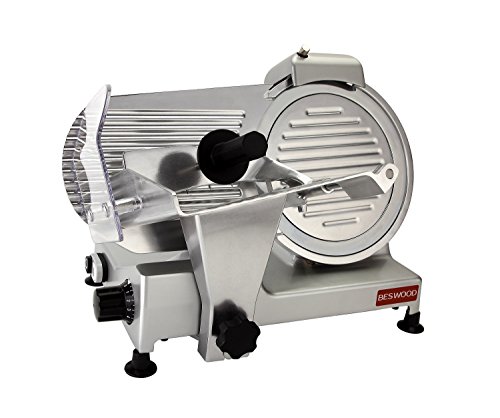
Mark the machine’s full operating envelope, not just its base. Confirm a suitable support surface, nameplate electrical requirements, unobstructed controls and a practical washing route before the slicer arrives. Follow the exact installation manual and local equipment requirements.
The BESWOOD250 occupies the step between a lightweight food slicer and a larger deli machine. Its listing identifies a 10-inch chromium-plated blade and 240W motor. The buying decision is whether that larger format earns its place on your counter through regular slicing, rather than whether a bigger blade looks more professional.
The VEVOR 10-inch 240W listing describes a chromium-plated blade and semi-automatic operation. It is a candidate for buyers comparing the larger circular-blade format with BESWOOD250, but similar dimensions in the title do not make their service support, carriage travel or permitted foods identical.
This 12-inch VEVOR listing advertises a 320W electric deli cutter. It belongs in a larger-machine comparison where the buyer has already measured product size and counter access. More blade diameter is useful only if the complete feed path accommodates the food you actually prepare.
Commission the station without rushing into production
Apply this to the shortlist
Review the station from the cleaner's position
A slicer station is more than a rectangle on a counter. It includes a moving carriage, an operator, incoming food, finished portions and the space needed to remove components for cleaning. The machine may fit on the table while the job still does not fit in the room.
Use this checklist when planning a new station or replacing equipment. It is a layout worksheet, not a substitute for model-specific installation instructions or an electrical assessment. Where lifting, wiring or servicing requires qualified help, arrange that before delivery.
Draw four boundaries on the plan
The first boundary is the machine's static footprint. The second is its complete motion envelope: carriage forward, carriage back and any handle or holder movement. The third is the operator's working position, including access to controls. The fourth is the service and cleaning envelope needed for approved disassembly and inspection.
Draw these at scale using the exact model's documentation. A photograph cannot establish clearance because perspective obscures travel. If a specification gives only external dimensions, request the missing operating measurements. Do not fill them with a rule of thumb from a different slicer.
Boundary
How to check it
Common conflict
Static base
Exact dimension drawing and support points
Counter edge or unsupported overhang
Moving assembly
Full approved carriage and holder travel
Wall, shelving upright or adjacent appliance
Operator
Standing position and control reach
Aisle traffic behind the operator
Cleaning access
Manual's component-removal sequence
Overhead shelf or inaccessible rear surface
Separate product flow from pedestrian traffic
Arrange incoming food and finished portions so that ordinary work does not require reaching across the cutting area. Test the layout with empty containers and a paper footprint before placing equipment. Include the largest tray normally used, not only a small sample plate.
Look behind the operator. A busy doorway, open refrigerator door or staff shortcut can cause interruptions and collisions. A slicer may be comfortable during a quiet walkthrough and awkward during service. Observe the route of people replenishing ingredients and removing waste before committing to the location.
If the station serves both raw preparation and ready-to-eat food work, resolve the separation and sanitation procedures with the person responsible for food safety. Layout should support those procedures. It should not force staff to carry soiled components across finished portions.
Check the table as equipment, not furniture
Confirm that the support surface can handle the actual machine and operating loads under the manufacturer's requirements. Include stability during carriage movement. A table that seems firm when pushed lightly may behave differently when a heavy assembly is repeatedly moved.
Check the surface condition and ability to clean around and beneath the equipment in its approved installation. Do not improvise wedges, feet or restraints to compensate for a poor fit. If the manual permits or requires a particular mounting method, use the specified arrangement.
For mobile tables, determine whether the equipment and table manufacturers permit the proposed use and what locking or restraint is needed. Moving a slicer is a separate handling task; it should not become a daily workaround for insufficient cleaning access.
Verify power from the nameplate and manual
Record required voltage, frequency, current and connection type for the exact delivered unit. Have the suitability of the supply assessed where needed. A similar product sold in another region may have different electrical requirements, so model names alone are insufficient.
Plan the cord route so it avoids moving parts, wet work and places where it can be caught. Keep access to the prescribed isolation method. Do not choose an extension lead or adapter as a default solution to a station in the wrong location; follow the manufacturer and applicable electrical requirements.
Protect the label containing the model and serial number from being obscured by the installation. Staff and technicians will need it for parts, documentation and service. Photograph the plate for the equipment file without relying on the photograph as a substitute for the permanent marking.
Design the cleaning route before delivery
Identify which components the manual allows the operator to remove. Measure those components against the washing facilities, and identify where they can drain or dry under the approved procedure. A large food carriage that does not fit the available sink creates a planning problem even if the machine fits the counter.
Separate the dirty receiving area from the space used for clean parts. Avoid placing disassembled guards among knives or loose utensils where they can be damaged or mistaken for scrap. Give each component a predictable location during the process.
The FDA warns that damaged seals and inaccessible food deposits can compromise sanitation. Placement must allow routine examination as well as wiping the visible surfaces. See FDA's slicer safety guidance and the site's sanitation scheduling guide.
Prepare a receiving and handling plan
Measure doorways, passage turns and any stairs along the delivery route. Arrange enough appropriate help or handling equipment for the documented weight and shape. Do not lift by a carriage, guard or control unless the manufacturer explicitly identifies it as an approved lifting point.
On arrival, inspect the packaging and accessible equipment for shipping damage before normal use. Check that supplied components match the packing information and that the delivered model matches the order. Record any discrepancy promptly through the seller's documented process.
Keep the packaging until the initial acceptance checks and applicable return considerations have been addressed. A heavy appliance can be difficult to return without its proper protection. That practical detail belongs in the purchase plan, even though it is easily overlooked when comparing features.
Commission the station without rushing into production
Read the delivered manual and identify the operating controls, guards and permitted setup sequence.
Complete the prescribed first-use cleaning and inspection.
Position the equipment on the approved support, with the full operating envelope clear.
Confirm the electrical connection and isolation arrangement.
Have trained staff demonstrate the specified assembly checks before operation.
Run only the checks and food trials allowed by the manual, with all protection restored.
Record faults or uncertainties and resolve them before routine service.
A successful power-on is not a complete commissioning result. The station must also support receiving slices, stopping safely, cleaning and returning the machine to service. Ask a second trained person to walk through the process; they may find an awkward reach that the layout designer missed.
Apply this to the shortlist
For the BESWOOD250, VEVOR 10-inch B08R7JJF3R and VEVOR 12-inch B0GSYXKNX9 catalog candidates, obtain the exact variant's drawing and instructions. The BESWOOD manufacturer page lists more than one size, illustrating why a shared product page needs careful interpretation. A larger blade listing should prompt a new footprint check, not reuse of an earlier sketch.
Compare candidates in the commercial collection after eliminating machines that cannot be safely accommodated. If the remaining choices differ mainly in operating envelope, favor the station that works during cleaning and peak service, rather than the one that looks neat while idle.
Finally, retain the layout, serial number, manual and training record together. Recheck the layout whenever a refrigerator, shelf or adjacent appliance moves. Installation remains suitable only while the surrounding station continues to match the conditions that made it workable.
Review the station from the cleaner's position
After the operating layout looks satisfactory, ask the person who will clean it to identify every component's path to washing and back. Check where the manual can be consulted without becoming wet and where an out-of-service notice can be placed if a defect is discovered. A station designed only around slicing often leaves these details unresolved.
Resolve the problems on the drawing where possible. Moving a paper outline costs much less effort than moving a heavy machine after the electrical supply and neighboring equipment have been arranged.
Check the model against your decision
VEVOR 12-inch 320W slicer: Confirm net weight, working footprint, feed capacity, protective devices and service arrangements.
As an Amazon Associate, we may earn from qualifying purchases.