A used slicer is worth considering only when its identity, condition, guards, sanitation surfaces and service path can be verified. Compare the inspected ready-to-use cost with a suitable new model. An unknown repair bill can erase the apparent discount.
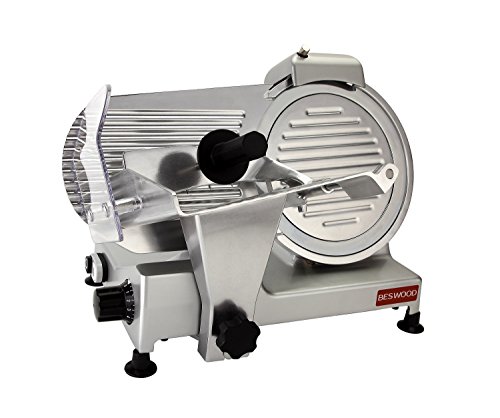
The BESWOOD250 occupies the step between a lightweight food slicer and a larger deli machine. Its listing identifies a 10-inch chromium-plated blade and 240W motor. The buying decision is whether that larger format earns its place on your counter through regular slicing, rather than whether a bigger blade looks more professional.
The VEVOR 10-inch 240W listing describes a chromium-plated blade and semi-automatic operation. It is a candidate for buyers comparing the larger circular-blade format with BESWOOD250, but similar dimensions in the title do not make their service support, carriage travel or permitted foods identical.
This 12-inch VEVOR listing advertises a 320W electric deli cutter. It belongs in a larger-machine comparison where the buyer has already measured product size and counter access. More blade diameter is useful only if the complete feed path accommodates the food you actually prepare.
Identify the machine before discussing the discount
Separate repairable uncertainty from a reason to walk away
Inspect cleanability with the same seriousness as cutting
Ask what has been replaced and why
Calculate the ready-to-use price
Inspect the transaction as well as the equipment
Where a new machine earns its premium
Where used makes sense
Do not confuse history with remaining life
A used commercial slicer can offer a capable machine at a lower initial price, but age and appearance do not establish its condition. A polished housing may conceal missing components, worn seals or a blade approaching its replacement limit. The central question is how much uncertainty remains after inspection.
This guide treats the inspection as part of the purchase, not as something to do after a bargain is delivered. It does not provide instructions for unqualified electrical or mechanical repair. Where condition cannot be established safely, use an authorized or appropriately qualified service professional.
Identify the machine before discussing the discount
Ask for clear photographs of the model and serial plate, the full machine and all supplied components. Match the model to the correct manual and parts information. If the plate is missing or unreadable, the buyer may struggle to establish instructions, approvals or part compatibility.
Do not accept a seller's estimate that it is probably the same as a current model. Production changes can alter guards, blades, fasteners and electrical components. A superficially similar machine is not a dependable parts reference.
Confirm the supply requirements for the actual unit. Used equipment may have moved between premises or regions. A plug that fits an outlet does not by itself establish that the equipment has the correct electrical configuration or is in safe condition.
Separate repairable uncertainty from a reason to walk away
Finding
Next step
Buying implication
Complete identity and service records
Verify the records match the serial number
Useful evidence, still inspect current condition
Missing guard or food holder
Obtain exact approved replacement and professional assessment
Do not operate or assume a cheap universal part fits
Damaged seals or inaccessible deposits
Have the sanitation defect assessed
Not ready for food use
Unknown blade wear
Check against manufacturer limits through qualified inspection
Include possible replacement cost
Untraceable model or altered wiring
Require competent evaluation and documentation
Uncertainty may outweigh the discount
Some defects have a clear, available repair. Others leave the machine's suitability unresolved. Do not combine them into a single vague allowance for maintenance. A quotation for an exact approved part is different from hoping an equivalent component will appear later.
Inspect cleanability with the same seriousness as cutting
FDA's deli-slicer guidance identifies damaged seams and seals as potential places for trapped food and moisture. It advises taking equipment with defective seals or gaskets out of service and obtaining appropriate repairs. That is particularly relevant to a used machine with an unknown cleaning history. See the FDA inspection guidance.
Ask the service professional to examine the machine's food-contact condition and the areas exposed by the approved cleaning procedure. Surface shine is not the inspection standard. Old residue, corrosion, cracks and nonstandard sealant deserve specific findings rather than an assurance that a deep clean will fix everything.
If a seller will not permit a reasonable inspection, price is not enough to remove the uncertainty. A machine that cannot be adequately cleaned is not a useful food-production asset, even if its motor runs smoothly.
Ask what has been replaced and why
Obtain invoices for recent blades, bearings, switches, cords or other significant work. Confirm the parts were appropriate to the exact machine. A repair history can be reassuring when it is documented, but repeated unexplained repairs may indicate a problem that has not been resolved.
Ask whether sharpening and maintenance followed the manufacturer's procedure. Do not judge remaining blade life from a seller's statement that it still feels sharp. Blade dimensions, condition and clearance must be assessed against the model's criteria.
For equipment described as refurbished, request the actual scope: inspected components, replaced parts, tests performed and any warranty. Refurbished is not a uniform technical standard. A documented service process is more useful than the label.
Calculate the ready-to-use price
Use an illustrative worksheet with your own quotations. Suppose a used machine costs $350, inspection costs $100, approved repairs cost $180 and transport costs $70. Its ready-to-use cost is $700 before any further downtime. These numbers are an example, not current prices for a model.
Compare that total with a new machine that actually meets the same workload and installation requirements. Comparing a repaired industrial machine with an unsuitable household unit would be misleading; comparing two suitable options allows a meaningful decision.
Add an uncertainty line for unresolved items, but do not use a cash reserve to excuse an unresolved safety defect. Some uncertainty can be priced; other uncertainty must be resolved before purchase or operation. Our ownership-cost guide separates these categories.
Inspect the transaction as well as the equipment
Clarify whether the sale is final, who pays for shipping damage and what happens if the machine differs from its description. Ask whether a professional inspection can occur before funds are committed. Written terms are especially important when the equipment must travel a long distance.
Verify what accessories are included. Missing removable parts can make an apparently complete machine unusable under its manual. A photograph of the assembled front may not show the sharpening assembly or other supplied components.
For an online used purchase, request packaging appropriate to the machine's weight and vulnerable assemblies. Damage during transport can turn a sound unit into a repair project. Include receiving inspection in the plan and avoid putting the machine straight into service.
Where a new machine earns its premium
A new purchase can simplify identity, documentation and the initial condition assessment, although it still needs acceptance checks. Clear seller terms and a documented service route may be worth more to a business that cannot tolerate uncertain commissioning time.
The manager catalog contains BESWOOD250 and VEVOR 10- and 12-inch candidates for a new-equipment comparison. Their current offer condition, seller and support terms must be checked on the actual offer; a catalog title alone does not prove those terms. Use the commercial collection as a starting point rather than assuming every offer is identical.
New does not automatically mean appropriate for commercial use. The same workload, local equipment and placement checks apply. A fresh machine with inadequate duty documentation can be a worse business purchase than a properly inspected and supported used model.
Where used makes sense
Used is most defensible when the exact machine is traceable, the condition is professionally established, approved parts remain obtainable and the complete cost is attractive against a suitable alternative. It also helps when the business has enough schedule flexibility to manage inspection and any documented repair.
Walk away when the purchase depends on bypassing a guard, ignoring a sanitation defect or assuming an unknown component will be easy to replace. Those are not negotiating points. They are unresolved requirements for putting the equipment into service.
Before committing, apply the installation checklist to the used machine's real dimensions and supply. Then compare its confirmed capacity with your peak-workload brief. A bargain becomes useful only when it can perform the required work in the actual premises.
Do not confuse history with remaining life
A machine used lightly for many years and one used intensively for a short period can have very different wear. Ask about the former business's food mix, operating pattern and storage conditions, but treat the answers as background rather than a substitute for inspection. A claimed low-use history is difficult to verify without records.
The purchase decision should rest on present condition and supportability. If the machine has been stored for a long time, have its readiness assessed before a food trial rather than assuming inactivity preserved every component.
Check the model against your decision
VEVOR 12-inch 320W slicer: Confirm net weight, working footprint, feed capacity, protective devices and service arrangements.
As an Amazon Associate, we may earn from qualifying purchases.