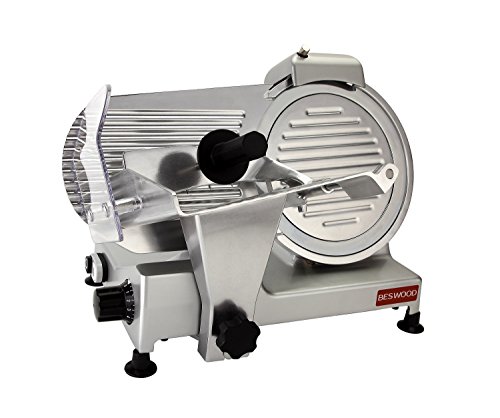
Both are ten-inch slicer candidates, but compare their documented food capacity, working space and operating instructions rather than treating equal blade diameter as equal performance. LEM publishes a thirty-minute run time; BESWOOD provides a defined cutting envelope. Neither fact alone makes one the better purchase.
The BESWOOD250 occupies the step between a lightweight food slicer and a larger deli machine. Its listing identifies a 10-inch chromium-plated blade and 240W motor. The buying decision is whether that larger format earns its place on your counter through regular slicing, rather than whether a bigger blade looks more professional.
LEM's BigBite 10-inch electric slicer is cataloged as a home-use appliance. Its appeal for a shortlist is the combination of a named product family and a larger blade than compact domestic machines. Jerky suitability still depends on the manual's permitted food state and the size of the prepared cut.
This CUSIMAX listing distinguishes itself with two removable 8.7-inch blades and a removable food carriage. It advertises a 1–20mm adjustment range. The practical question is whether the food-contact components you must wash can be removed in a way you are comfortable repeating after each session.
Make sure the comparison is between the right models
Documented differences that deserve attention
If your concern is food fit, start with a drawing
If your concern is batch length, compare instructions
Blade material is a care question before it is a ranking
Which one is easier to live with?
Choose BESWOOD when the confirmed fit favors it
Choose LEM when its documented workflow answers your need
When neither is the right next step
A final side-by-side purchase note
BESWOOD250 and the LEM BigBite ten-inch are plausible candidates when a small home slicer no longer suits the food or workload you have in mind. Comparing them by blade diameter produces a tie. Comparing their documentation produces a more useful set of questions.
This is a specifications-and-workflow comparison, not a hands-on test. We have not measured slicing consistency, noise, cleaning time or motor endurance on either machine. Where the official pages provide different kinds of information, that difference remains visible rather than being filled with an assumption.
Make sure the comparison is between the right models
The BESWOOD candidate is the BESWOOD250 ten-inch listing, ASIN B01AQH636Q. The LEM candidate is the BigBite ten-inch listing, ASIN B005QJJREK; LEM identifies its current ten-inch BigBite product as SKU 1020. Match the delivered model and documentation to the exact offer before relying on specifications.
Do not substitute an 8.5-inch BigBite, a MightyBite or a twelve-inch variant because a search result uses the same brand name. BESWOOD also displays size options on its manufacturer page. A comparison loses its value if a dimension or operating claim is silently borrowed from another selection.
Documented differences that deserve attention
Specification
BESWOOD250 ten-inch
LEM BigBite ten-inch
Listed blade material
Chromium-plated carbon steel
Stainless steel
Published motor input
240 W
330 W
Published run-time information used here
Not established from the product page
30 minutes
Capacity information
Defined cutting length and height
Carriage dimensions published
Cleaning consideration
Consult the supplied model manual
Manufacturer describes removable table, pusher and blade
These are manufacturer statements, not independently measured results. In particular, a tray dimension and a cutting envelope are not interchangeable. The table intentionally avoids turning them into a single maximum-food-size figure.
If your concern is food fit, start with a drawing
Measure the food you want to slice and sketch it in the intended orientation. Mark the face that becomes the finished slice, then the length of food behind that face. That drawing creates a specific question for either manufacturer: can this shape be supported and controlled throughout the permitted carriage movement?
BESWOOD’s stated cutting dimensions give you a useful starting point for that conversation. LEM’s published carriage measurements describe support space, but you should still confirm the usable cutting capacity for a close fit. Do not assume one accepts taller food simply because a tray looks larger in a photograph.
This distinction matters most for whole roasts and slabs. If you are happy to divide food into smaller portions, both candidates may remain viable and another factor can decide. If preserving the entire slice shape is essential, eliminate any machine that cannot demonstrate the required capacity.
The blade and capacity guide provides the measurement terms. Use the same food drawing for both candidates so that the answers are comparable. Asking “Can it handle large roasts?” invites a vague response; exact dimensions and orientation invite a useful one.
If your concern is batch length, compare instructions
LEM’s published thirty-minute run time is a concrete specification to consider. Compare it with the time your normal session requires and obtain the cooling and operating details from the applicable manual. Do not interpret it as an unlimited-duty claim.
The BESWOOD product page does not establish a comparable time limit in this review. That missing field is a question to resolve, not evidence that the machine is either better or worse. Ask for the model’s documented operating guidance before making session duration the deciding factor.
A larger wattage number cannot fill that gap. Electrical input is not a direct timed test of your food, feed technique or slice thickness. It would be misleading to calculate a percentage increase from 240 to 330 W and call that the increase in slicing productivity.
Write down the actual work sequence too. Loading, portioning and collecting food may occupy much of the session. A machine with a longer permitted interval has value when that interval is the bottleneck; it has less value if another part of your routine already determines the pace.
Blade material is a care question before it is a ranking
The two manufacturers describe different blade materials. That is a reason to read their care and replacement instructions, not enough evidence to declare a universal sharpness or durability winner. Edge condition, approved maintenance and actual use all matter.
Check how each maker expects the owner to clean and maintain the blade, and identify the exact replacement part. Consider whether you are comfortable with the documented procedure. If you expect professional service to handle some maintenance, investigate access before purchasing.
A built-in maintenance feature can be convenient, but it does not replace understanding when and how the manufacturer permits its use. Do not assume instructions from one slicer apply to the other because both have round blades and similar-looking assemblies.
Which one is easier to live with?
That question is personal and measurable. Make a footprint template for each model using confirmed dimensions, then allow for the actual working movement and food trays. Compare the places from which you would operate, clean and move the machine.
Neither belongs on a shortlist merely because it technically fits inside a cupboard. Think about the opening, the route to the counter and the handling method. If regular lifting would be awkward, a permanent location may be necessary. The space commitment can outweigh a modest purchase-price difference.
Cleaning access deserves a separate walkthrough. Read the permitted removal and reassembly process and identify where sharp components and other parts will be placed. The model whose procedure you can follow comfortably may be the more useful choice even if it has the less impressive headline specification.
For a detailed layout exercise, use the counter-space guide. Bring the completed sketch back to this comparison instead of deciding from photographs alone.
Choose BESWOOD when the confirmed fit favors it
BESWOOD becomes the stronger candidate for you when its documented capacity accommodates your food, its placement works and its current offer and support arrangements are acceptable. That is a conditional recommendation grounded in fit, not a claim that it outcuts LEM.
Before choosing it for long batches, resolve the operating-limit question with the exact manual. Before choosing it primarily on price, compare current offers that contain the intended model and included equipment. Avoid comparing one retailer’s temporary price with an outdated figure for the other machine.
Choose LEM when its documented workflow answers your need
LEM becomes the stronger candidate when its published run-time information and documented removable components fit the way you plan to use and maintain the slicer. Confirm the usable food dimensions and any operating conditions before treating the specification sheet as a final approval.
LEM’s official page also provides support and warranty information. Read the current terms for the seller and purchase route you intend to use rather than assuming every offer has identical coverage. Service accessibility can be a meaningful ownership factor even when it cannot be converted into a slicing-performance score.
When neither is the right next step
If your actual task is occasional small-portion slicing, both may represent more appliance than you need. A home-format candidate such as the CUSIMAX listing included here deserves comparison on verified capacity and footprint. It is presented as a smaller-format alternative, not an equivalent heavy-duty substitute.
If your task exceeds both machines’ confirmed limits, do not buy one and plan to push it harder. Investigate an appropriately documented commercial option. If an existing slicer’s output has merely deteriorated, consider maintenance and support before assuming the answer is replacement.
A final side-by-side purchase note
Complete these five lines for each model: the food fits; the operating guidance fits the batch; the machine fits the workspace; the cleaning procedure is manageable; the exact current offer and support terms are understood. A blank line identifies the next question to ask.
Then compare the home slicer options or the commercial collection using the same requirements. The best outcome from this comparison is not a universal brand winner. It is choosing the machine whose documented limits and ownership routine match the work you actually intend to do.
Check the model against your decision
CUSIMAX 8.7-inch two-blade slicer: Verify each blade's edge type, the model number on the current offer, duty cycle and approved cleaning method.
As an Amazon Associate, we may earn from qualifying purchases.