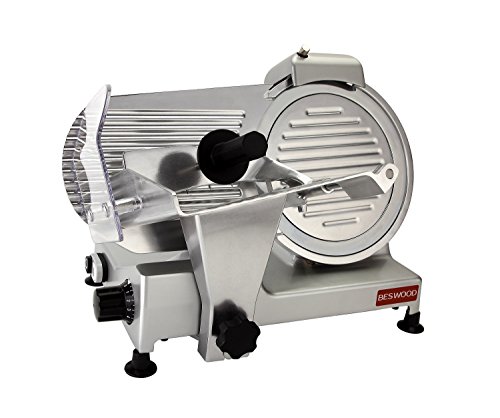
Compare BESWOOD250, ASIN B01AQH636Q, with the specific VEVOR 10-inch 240W listing, ASIN B08R7JJF3R. Both catalog titles describe 10-inch, 240W machines, but those shared numbers do not establish equal performance. Resolve model documentation, food limits and support before choosing.
The BESWOOD250 occupies the step between a lightweight food slicer and a larger deli machine. Its listing identifies a 10-inch chromium-plated blade and 240W motor. The buying decision is whether that larger format earns its place on your counter through regular slicing, rather than whether a bigger blade looks more professional.
The VEVOR 10-inch 240W listing describes a chromium-plated blade and semi-automatic operation. It is a candidate for buyers comparing the larger circular-blade format with BESWOOD250, but similar dimensions in the title do not make their service support, carriage travel or permitted foods identical.
This 12-inch VEVOR listing advertises a 320W electric deli cutter. It belongs in a larger-machine comparison where the buyer has already measured product size and counter access. More blade diameter is useful only if the complete feed path accommodates the food you actually prepare.
Do not compare prices until the offer is equivalent
What about the 12-inch VEVOR?
A fair decision rule
Questions to send both suppliers together
A comparison worksheet you can finish
Compare the first month, not only the first cut
VEVOR versus BESWOOD is too broad a question until the exact products are named. VEVOR appears in the catalog with several blade sizes and power descriptions. BESWOOD's classic product page also offers size variations. Comparing a brand name on one side with a specific machine on the other can quietly mix different products.
This analysis centers on the manager-returned BESWOOD250, ASIN B01AQH636Q, and VEVOR's 10-inch 240W listing, ASIN B08R7JJF3R. The VEVOR 12-inch 320W listing, B0GSYXKNX9, appears only as a separate capacity candidate. We have not conducted a side-by-side cutting, noise or endurance test.
These are catalog statements and limited manufacturer context, not proof that the products perform identically. In particular, the word frozen in a listing should not be treated as permission to put any hard-frozen food into the machine. The exact manufacturer's instructions must define permitted food condition.
The same discipline applies to wattage. Matching electrical input figures do not establish equal torque under load, slice consistency or service life. A comparison that names a winner from those two numbers alone has not answered the useful buying questions.
Where BESWOOD's documentation helps
BESWOOD's classic product page identifies the BESWOOD250 and provides variant specifications. It states a 10-inch cutting envelope of 210mm length and 170mm height, alongside other information. Check the selected variant carefully because the same page also lists a 9-inch version.
That documentation gives a buyer concrete dimensions to compare with a food block. It does not establish that every commercially relevant food, batch duration or use case is approved. Obtain the operating manual and ask about the actual job rather than extending the dimensions into a duty claim.
The manufacturer page also describes cheese among the food applications. This makes BESWOOD a reasonable candidate for a cheese-specific inquiry, but a generic food statement does not answer how long a particular cheese batch may run. The cheese selection guide explains the additional questions.
Where the VEVOR comparison needs restraint
The manager inventory includes several VEVOR slicers, including smaller household-style sizes and distinct 10-inch listings. Do not transfer a manual, review or specification between them merely because their photographs look similar. The candidate in this comparison is B08R7JJF3R.
Before purchase, ask for its manufacturer model identifier and matching manual. Confirm the blade description, cutting envelope, electrical supply, carriage mechanism and permitted foods from that document. If the offer changes variant, repeat the match instead of assuming the ASIN-level comparison still applies.
We do not have sufficient model-matched technical evidence here to declare a VEVOR disadvantage in reliability or a BESWOOD advantage in motor strength. Missing evidence is a reason to investigate, not a license to fill a comparison chart with unfavorable guesses.
Choose according to the unresolved job
For occasional household batches
Measure the actual storage and working space before treating either commercial-style machine as an upgrade. A heavier, larger machine can be less convenient if it must be moved before every use. Consider the full setup and cleaning burden, not only the cutting result you hope to obtain.
If the task is a small weekly portion of one permitted food, documented suitability and practical handling may matter more than differences that cannot yet be measured. The broader meat slicer selection page helps compare categories before narrowing to these two listings.
For a deli or restaurant
Require the documentation your local authority expects and a written answer about your peak workload. Neither a commercial title nor a manufacturer's general badge substitutes for confirming the exact model and accepted use. Keep the equipment approval and the workload decision separate; passing one does not prove the other.
Compare service arrangements in the location where the machine will operate. Who diagnoses a fault? Where do replacement components come from? Must the entire unit be shipped? Those answers may change the choice more than the catalog's shared blade size.
For cheese and mixed ingredients
Send the same named foods and batch description to both suppliers. Ask each for permitted operating conditions and any restrictions. If only one supplies a usable answer, that is a documentation advantage for your decision, not a universal declaration that its hardware is superior.
Include the transition between foods and the cleaning procedure in the comparison. A machine that handles the product but does not fit the station's sanitation process is not the right choice for that business.
Compare the user tasks that specifications omit
Look for a clear approved process for component removal, access to the blade area and restoration of guards. The presence of a removable part is not enough; its size and weight must work with your facilities and staff. Ask for the manual's procedure before estimating cleaning time.
Check where finished slices land and whether the intended receiving tray fits. Think through the food holder at the start and end of a block. These practical details can be more important than a marketing claim about a thin minimum setting.
Where a supervised demonstration is available, use the same permitted food, target thickness and finished-portion standard for both machines. Record usable output, rejected slices and complete task time. Avoid comparing one product's promotional video with another's difficult real-world batch.
Do not compare prices until the offer is equivalent
Current Amazon prices and availability can change, and the catalog data used here does not establish a live offer price. Check the exact variant, seller, condition, included components and return terms on the offer you intend to use.
A lower initial amount can disappear into shipping, missing components or inconvenient service. Conversely, a higher-priced offer is not automatically better supported. Read the terms and ask who is responsible for the specific service you expect.
For business use, carry both candidates into the ownership-cost worksheet. Use identical labor and operating assumptions until measured evidence justifies a difference. Do not make a preferred product appear cheaper by assigning it an invented cleaning advantage.
What about the 12-inch VEVOR?
The B0GSYXKNX9 catalog title identifies a 12-inch 320W model. It should be a separate comparison if your food dimensions or workload require investigating a different size. It is not a substitute data source for the 10-inch VEVOR discussed above.
A larger blade may coincide with a different footprint and cutting envelope, but those details need the exact documentation. It can also change handling and cleaning logistics. Do not assume that moving up a size solves an unverified duty-cycle question.
A fair decision rule
Prefer the candidate that can be shown to fit your food, schedule, premises and support needs. If both qualify, compare complete offer terms and practical operating tasks. If one lacks essential documentation, keep it off the final purchase list until that uncertainty is resolved.
For readers who want a single brand winner, the available evidence does not support one. BESWOOD provides useful manufacturer details for a specific classic model; VEVOR offers multiple distinct candidates whose identities must be kept separate. Neither point is a substitute for a controlled performance comparison.
Use the commercial slicer collection to retain the exact ASINs while gathering answers. Then take the surviving options through the commercial buying guide. A purchase grounded in a documented job is more defensible than a verdict based on brand familiarity.
Questions to send both suppliers together
Send a single concise message identifying the model and your largest food dimensions, longest batch, required thickness and operating location. Ask for the matching manual, the permitted workload, relevant equipment documentation and the exact service process. Request clarification of any listing wording that conflicts with the instructions.
Keep the replies beside the comparison table and date them. If a seller responds with a different model or a general product-family brochure, the original question remains unanswered. This small discipline prevents a convincing but irrelevant reply from becoming the basis of the purchase.
Once the evidence is complete, record why you selected the machine: for example, confirmed block fit and accessible parts, rather than an unsupported claim of best quality. That record helps staff understand the operating limits and gives a future replacement purchase a clear starting point.
A comparison worksheet you can finish
Create a row for each unanswered requirement and assign an evidence source. Food limits should come from the matching instructions or manufacturer confirmation. Current seller terms should come from the actual offer. Physical fit should come from exact dimensions checked against your station. Measured slice quality requires an appropriate trial rather than a specification copied from another listing.
Give every row one of three states: confirmed, conflicting or unknown. Conflicting evidence deserves more attention than an ordinary blank. For example, if a title suggests a food application that the manual excludes, follow the restrictive instruction and ask for clarification before purchase. Do not select whichever wording supports the desired conclusion.
For confirmed information, note the model and date. This matters when a page hosts several variations or a seller changes its offer. A screenshot of a different size is not adequate support for the selected unit, even if the brand and product-family name match.
Compare the first month, not only the first cut
Think through where the machine will be kept, who will clean it and how spare components will be identified. A home buyer moving the machine from storage for each session faces a different convenience calculation from a restaurant with a permanent station. The best fit can differ even when both users slice the same meat.
For a business, identify the support contact before the first service. Save the model, serial number and purchase documentation where the manager can retrieve them if the operator is absent. A clear record will not prevent every fault, but it avoids delaying a service request while staff try to identify the equipment.
These details do not produce a dramatic brand ranking. They produce a more useful decision: a specific model that fits a specific user, with its limits understood. If neither listing can yet be qualified, the honest next step is to obtain the missing evidence or investigate another documented option, not to guess which brand will work.
Check the model against your decision
VEVOR 12-inch 320W slicer: Confirm net weight, working footprint, feed capacity, protective devices and service arrangements.
As an Amazon Associate, we may earn from qualifying purchases.