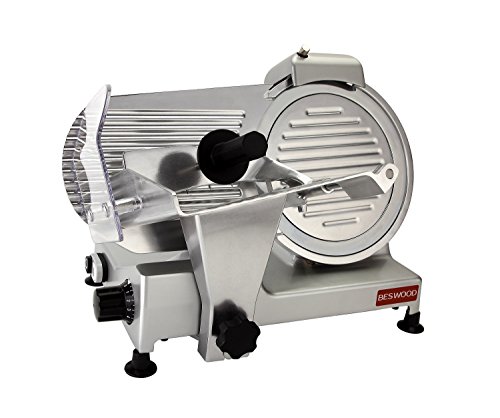
Choose a slicer explicitly documented for the cheese and workload you intend to cut. A meat-slicing claim, large blade or high wattage does not establish cheese capacity. Confirm block fit, permitted operating time and the required cleaning process before buying.
The BESWOOD250 occupies the step between a lightweight food slicer and a larger deli machine. Its listing identifies a 10-inch chromium-plated blade and 240W motor. The buying decision is whether that larger format earns its place on your counter through regular slicing, rather than whether a bigger blade looks more professional.
The MS-12ES listing names a 12-inch blade, 420W motor and extended back space. That last feature makes this model worth a separate dimensional investigation when ordinary food supports restrict the pieces you want to slice. Do not convert extended back space into an assumed capacity figure.
Keep texture adjustments within food and machine instructions
What the documented catalog supports
Watch the receiving side of the station
Plan the milk-allergen changeover
Choose this route when the evidence fits
Specify the result on the plate
Cheese is often treated as a small extra task when a kitchen buys a meat slicer. That can be the wrong assumption. A machine selected around a few ham portions may face a very different job when asked to process a full cheese block for sandwiches.
The relevant question is not simply whether a blade can cut cheese once. It is whether the equipment can repeatedly produce the required slices, within its documented limits, while fitting your portioning and sanitation process. This guide helps specify that job without awarding unsupported performance claims.
Describe the cheese before choosing the machine
Write down the actual varieties and purchase formats. A firm rectangular sandwich block, a soft fresh cheese and an aged wedge do not present the same shape or handling problem. Record the block's dimensions as supplied and the serving result you want.
Include the intended thickness and whether slices need to separate cleanly for individual portions. A machine might cut a product while the resulting pieces are unsuitable for your serving method. The acceptance standard should describe the finished portion, not merely the presence of a cut.
Menu requirement
Detail to give the supplier
Question to resolve
Sandwich cheese
Named variety, block size and daily batch
Documented repeated-use suitability
Soft cheese portioning
Texture and presentation requirement
Whether a slicer is the appropriate tool at all
Aged cheese
Hardness, shape and serving style
Permitted food and handling limitations
Mixed deli work
Sequence with meats and allergen-sensitive orders
Changeover and cross-contact procedure
Require an answer tied to the exact model
Search the manufacturer's instructions for explicit cheese suitability and any associated limitations. Where only a broad statement is available, ask the manufacturer about your named cheese, block dimensions and longest batch. Save that response with the purchase record.
A brand can sell several slicers with different designs. Evidence for one does not qualify another. A retailer title mentioning meat, bread and cheese is a listing claim, not a measured duty rating. It deserves follow-up rather than being copied into a recommendation as fact.
Do not fill the gap with motor wattage. Input power alone does not describe the transmission, blade geometry, thermal limits or the complete food-handling system. Two similarly rated machines can have different intended uses, and a more powerful title does not resolve missing instructions.
The block must fit throughout the cut
Compare the food dimensions with the stated cutting envelope and holder capacity. Blade diameter is not the same measurement. A ten-inch blade does not mean that a ten-inch-tall block can be safely supported and cut.
Think through the final portion of the block as well as the beginning. The approved holder must retain useful control as the food becomes smaller. Do not plan to finish awkward remnants by moving fingers closer to the cutting zone or bypassing the holder. A realistic yield estimate includes any remainder that cannot be safely sliced.
If the supplier recommends reducing the block first, include that preparation in the workflow and ensure it is an appropriate food-preparation method. Buying a large block may save ingredient cost while adding handling time. The whole process determines whether it is worthwhile.
Keep texture adjustments within food and machine instructions
Operators sometimes try to solve dragging or smearing by making cheese colder or forcing it through faster. Do not use an uncontrolled temperature change or added force as a substitute for compatible equipment. Follow food-storage requirements and the manufacturer's permitted food condition.
Hard-freezing an ingredient to make it easier to handle can create a different load than the slicer allows. A reference to frozen food in another product's title is not permission for your machine. If the desired texture cannot be achieved within approved conditions, investigate another portioning method.
During a permitted demonstration, evaluate slice separation, surface appearance and consistency using the intended serving method. Record the cheese, its condition and the setting so that a successful result is not generalized to every variety.
What the documented catalog supports
BESWOOD's product page for its classic slicer describes cheese among its intended foods. The manager catalog identifies BESWOOD250 as ASIN B01AQH636Q. That makes it a candidate for a cheese-suitability discussion, but the general statement does not establish unlimited cheese duty or a guarantee for every block.
The manager catalog also identifies KWS MS-12ES, ASIN B08JHC8MSS. Its exact manufacturer product page explicitly includes cheese among the applications, and the linked manual includes MS-12ES in its covered models and discusses cheese slicing. This supports considering that named model; it does not establish a tested cheese-throughput rate or permission for every cheese batch. Confirm the delivered model, block dimensions and operating schedule before choosing it.
VEVOR 10-inch ASIN B08R7JJF3R remains an unqualified comparison candidate for this task: no model-matched cheese permission has been established here. It should not be presumed suitable merely because it is sold as a commercial slicer. Compare documentation through the commercial slicer collection; keep that model off a final cheese shortlist unless its manufacturer confirms the intended use.
We do not rank these candidates by cheese speed or slice quality because no controlled comparative trial has been performed here. The useful distinction is the evidence you can obtain before purchase and whether it answers your actual job.
Watch the receiving side of the station
Cheese portions may need separating, arranging or weighing immediately after cutting. Include the appropriate receiving space and staff task in a demonstration. Fast carriage movement is not useful if portions collect in a form that needs substantial rework.
Set the output target as usable portions per completed batch. Count pieces that tear, cling together or fail the presentation requirement separately. This produces a more honest buying comparison than the number of carriage strokes per minute.
For high-volume work, discuss whether the machine and receiving process are designed for that workload. An inexpensive slicer that can make a few acceptable pieces may still be the wrong production tool. Our workload guide explains how to include these downstream tasks.
Plan the milk-allergen changeover
Cheese introduces milk residue to the food path. Where the next product or customer requires control of milk cross-contact, the business needs an appropriate validated procedure or suitable equipment separation. Do not call the next serving milk-free merely because the visible cheese has been removed.
Cleaning, sanitizing and allergen control answer related but different questions. A sanitation chemical alone should not be assumed to remove allergen residues. Refer to the establishment's food-safety plan, applicable requirements and approved cleaning method for the equipment.
The cleaning-frequency article addresses scheduling; it is not an allergen-free certification for shared equipment. Staff must be able to explain what their process can and cannot assure.
Choose this route when the evidence fits
For occasional named cheese varieties, shortlist a model with explicit documented suitability and confirm that the batch fits its limits. For repetitive cheese production, demand stronger workload evidence and a representative demonstration. For very soft or unusual presentation requirements, consider whether a slicer is the wrong category before expanding the budget.
Bring the supplier a one-page brief: cheese names, maximum block dimensions, required slices, longest run, available preparation time and cleaning constraints. That brief creates a concrete yes-or-no discussion. It also makes it easier to reject a vague promise that the machine cuts everything.
When the evidence remains incomplete, keep the product as a candidate rather than treating it as the answer. A documented limitation discovered before purchase is valuable; discovering it halfway through a large service batch is much more costly.
Specify the result on the plate
Before a demonstration, decide how much variation the menu can tolerate. A folded sandwich portion may accept a different appearance from a cheese board where every slice is visible. Give the evaluator an example of the intended presentation and weigh a normal serving. This avoids rejecting useful equipment for an irrelevant cosmetic issue or accepting output that the kitchen must later repair.
Keep the acceptance criteria the same across candidates. Changing the cheese, thickness or presentation requirement halfway through the comparison makes the results difficult to interpret.
Check the model against your decision
KWS MS-12ES: Compare working clearance and food capacity against the standard KWS configuration, then confirm the exact offer.
As an Amazon Associate, we may earn from qualifying purchases.