Use properly prepared bacon in the condition allowed by your slicer manual, square the slab on a separate board, and keep it fully supported with the food holder. Make a few test slices before processing the batch. Stop if fat smears, the slab shifts or the machine struggles.
This CUSIMAX listing distinguishes itself with two removable 8.7-inch blades and a removable food carriage. It advertises a 1–20mm adjustment range. The practical question is whether the food-contact components you must wash can be removed in a way you are comfortable repeating after each session.
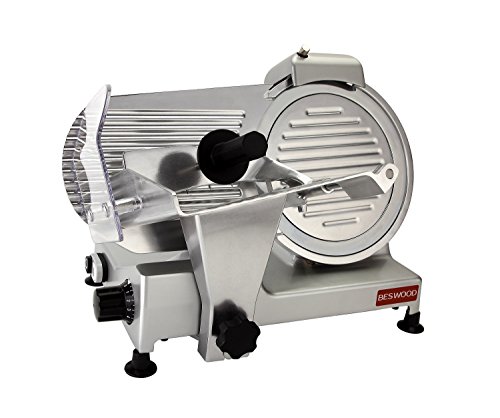
The BESWOOD250 occupies the step between a lightweight food slicer and a larger deli machine. Its listing identifies a 10-inch chromium-plated blade and 240W motor. The buying decision is whether that larger format earns its place on your counter through regular slicing, rather than whether a bigger blade looks more professional.
This 12-inch VEVOR listing advertises a 320W electric deli cutter. It belongs in a larger-machine comparison where the buyer has already measured product size and counter access. More blade diameter is useful only if the complete feed path accommodates the food you actually prepare.
Lay out the session while the bacon stays refrigerated
Read the slab before loading it
Start with a usable slice, then reduce thickness
Keep one small batch as a cooking reference
When the strips begin to deteriorate
Handle the heel as a separate ingredient
Package by the meal you will actually cook
Equipment candidates if the batch exposes a limitation
The first few pieces from a homemade bacon slab rarely tell the whole story. An uneven end may produce scraps before a full face reaches the blade; later, a softer section may behave differently from the leaner portion. Treat the opening cuts as an adjustment stage, then judge a small representative group before committing the rest of the slab.
This guide begins with bacon already produced under an appropriate food-safety process. It is not a curing or smoking recipe. Slicing cannot make inadequately cured, cooled or stored meat safe, and a pink color or smoky smell does not determine whether bacon is ready to eat.
Lay out the session while the bacon stays refrigerated
Prepare the receiving container, portion packaging and labels before bringing out the slab. Locate the model’s operating directions and check its permitted food conditions. A bacon recipe’s suggestion to firm the meat in a freezer does not override a slicer manual that excludes frozen food. The correct condition must satisfy both the food preparation method and the equipment limits.
Make a plan for the unsliced remainder. If the slab exceeds capacity, decide how to divide it on a separate board; do not discover the problem halfway through a carriage stroke. For a machine comparison based on this measurement, use the whole-slab buying guide.
Keep the packaging operation out of the moving carriage’s space. Position the collection container where it does not obstruct controls or encourage reaching around a running blade. A second person can package portions elsewhere, but only one person should control the slicing operation. Pausing the machine is preferable to trying to coordinate hands near its cutting area.
Read the slab before loading it
Observation on the separate board
Why it matters
Preparation decision
Tapered or irregular end
Initial cuts may not form complete strips
Expect a small opening section of partial pieces
Long unsupported edge
The food can twist during travel
Divide to a supported size or use suitable equipment
Rind or exceptionally firm outer layer
The exterior may cut differently from the interior
Check the manual and prepare separately if necessary
Soft fat that deforms when handled
The slab may compress against the plate
Reassess preparation and permitted food condition
Packaging, twine or hard inclusions
They are not part of the slicing task
Remove with the food away from the machine
Choose the face that produces the strip shape you intend. Rotating a rectangle may turn a long breakfast strip into a shorter, wider piece. There is nothing wrong with the latter for sandwiches or diced preparations, but make the choice deliberately. Photographing the orientation on the board can make your next batch easier to reproduce.
Start with a usable slice, then reduce thickness
An extremely fine setting gives you little margin for irregular food. Begin at a setting expected to produce an intact piece within the machine’s documented range. Move the carriage as directed, using its handle and food holder. If a complete piece emerges cleanly, inspect it away from the slicer before deciding whether to adjust thinner.
Do not judge by the first fragment alone. A sloping slab end can yield a wedge even when the gauge and carriage are working correctly. Once a full cutting face is established, look at several consecutive pieces. A repeating taper suggests an alignment or support issue; a one-time partial slice may simply reflect the original shape.
Compare the center and the ends of a finished strip without touching the cutting mechanism. If one end is consistently thicker, check how the slab sits and whether the holder is maintaining its position. More pressure is not a reliable correction: it may distort the soft layers further. Stop and reset according to the manual before continuing.
Keep one small batch as a cooking reference
Set aside a few strips from your chosen setting and a few from one slightly thicker setting. Label them before cooking using the same method. This gives a practical comparison of crispness, chew and portion size without pretending there is one universal bacon thickness. The deli thickness guide can help translate descriptive terms into starting points.
Suppose your thinner sample separates easily but becomes too fragile for a breakfast sandwich. The thicker sample might be preferable even if its uncooked appearance looks less like store bacon. Conversely, thicker strips can dominate a small sandwich. The successful setting is the one that works after cooking and assembly, not the one that makes the most impressive stack.
Record the slab type, orientation and dial position alongside your result. A setting alone will not explain a change next month if the new bacon has a different fat distribution or comes from a differently shaped cut. Think of the note as a recipe detail specific to your ingredients, rather than a calibration certificate for the slicer.
When the strips begin to deteriorate
If early slices were clean but later ones smear, pause instead of speeding up. The food may have changed condition during handling, residue may have accumulated, or the slab may have reached a portion that is harder to support. Determine which changed first. Return food to appropriate storage while resolving the issue, and follow the appliance’s cleaning procedure when residue needs removal.
For slices that split along a natural fat seam, inspect whether the meat itself separates on the board. Not every tear proves a dull blade. For a ragged edge across both lean and fat, inspect permissible maintenance and blade condition with the appliance made safe as instructed. A damaged blade or unstable mechanism calls for service, not an improvised sharpening session.
For a motor that slows sharply or a carriage that binds, stop using the machine. Do not repeatedly push through the difficult section to salvage one more strip. An oversized piece, disallowed food condition or equipment problem should be resolved before another attempt. See the texture diagnostic guide for the distinction between food failure and machine symptoms.
Handle the heel as a separate ingredient
The last piece eventually becomes too small for the holder to control properly. That point depends on the appliance and the shape of the food, not your determination to achieve zero waste. Stop while the remainder can still be handled safely. Set it aside on a separate board for a suitable recipe preparation; never use fingertips to finish it at the blade.
Ends can have a legitimate role in recipes that call for chopped bacon. Label them separately so they do not disappear into a package intended for uniform strips. This makes yield planning more honest: total edible bacon and total matching breakfast strips are different quantities. Choosing equipment on the promise of absolutely no heel waste would be unrealistic.
Package by the meal you will actually cook
Arrange portions around your usual meal size instead of making one large, tightly packed stack. Smaller packages reduce how much you need to handle for a single recipe. Use storage materials suitable for food and your chosen storage method, mark dates and follow the guidance applicable to the bacon you prepared.
FoodSafety.gov’s storage chart provides food-category guidance; homemade processing methods may require more specific instructions. Cutting a fresh surface does not restart a product’s storage clock. Keep the original preparation and opening information with your portion labels.
Equipment candidates if the batch exposes a limitation
A CUSIMAX 8.7-inch candidate, ASIN B0C4YKDMDM, is relevant when portioned slabs and removable carriage access are the main purchasing questions. The BESWOOD250, ASIN B01AQH636Q, is a larger deli-format candidate to examine for a dedicated station. The VEVOR twelve-inch candidate, ASIN B0GSYXKNX9, belongs in a capacity comparison when the smaller formats fail your measurements. These are catalog-based options, not verified claims that your slab will fit any of them.
Compare them in the bacon and deli collection after measuring the specific limitation revealed by the batch. Buy a different machine for an identified fit or documented operating need. If the problem was a tapered end or an unsupported heel, correcting the preparation may be enough.
Check the model against your decision
VEVOR 12-inch 320W slicer: Confirm net weight, working footprint, feed capacity, protective devices and service arrangements.
As an Amazon Associate, we may earn from qualifying purchases.