Measure the bacon slab and check the slicer’s permitted food size, carriage travel and holder clearance before comparing blade diameter. A larger blade alone does not guarantee full-length strips. If shorter strips suit your cooking, dividing the slab can make a smaller machine practical.
This CUSIMAX listing distinguishes itself with two removable 8.7-inch blades and a removable food carriage. It advertises a 1–20mm adjustment range. The practical question is whether the food-contact components you must wash can be removed in a way you are comfortable repeating after each session.
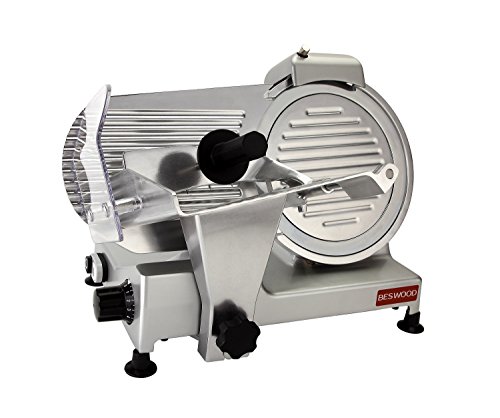
The BESWOOD250 occupies the step between a lightweight food slicer and a larger deli machine. Its listing identifies a 10-inch chromium-plated blade and 240W motor. The buying decision is whether that larger format earns its place on your counter through regular slicing, rather than whether a bigger blade looks more professional.
This 12-inch VEVOR listing advertises a 320W electric deli cutter. It belongs in a larger-machine comparison where the buyer has already measured product size and counter access. More blade diameter is useful only if the complete feed path accommodates the food you actually prepare.
Write the bacon requirement before the equipment shortlist
Blade diameter answers only part of the fit question
Compare three equipment directions
The texture problem is separate from the size problem
Judge thickness by the cooked result you want
Calculate the cost of owning the wrong format
Cleaning access deserves a purchase demonstration
Questions that separate a usable answer from sales language
Use a paper footprint before committing counter space
Make the final choice around the strip
The disappointing bacon-slicer purchase is often a machine that cuts neatly but cannot take the slab the owner buys. A listing photograph shows a compact deli loaf, while the actual job is a broad rectangle of belly bacon. Those foods ask different things of the carriage. Before comparing motors, decide whether you need unbroken breakfast strips or simply consistent pieces for sandwiches, roasting and lardons.
Write the bacon requirement before the equipment shortlist
Measure a representative slab on a separate preparation surface. Record its longest dimension, its width and its thickest point. Then describe the slice you want to serve. A long strip requires the cutting face to pass completely through the blade path while the remainder stays supported. Turning a slab ninety degrees changes the strip shape; it does not solve every clearance problem.
Do not confuse the slab’s weight with its fit. Two pieces weighing the same amount can be a short, thick block and a long, thin belly. A seller’s capacity stated only in pounds leaves the important question unanswered. Ask for maximum food dimensions in the operating position, with the supplied holder engaged, rather than the outside measurements of the machine.
Your actual requirement
Evidence to request
What would rule a machine out
Full-length breakfast strips
Permitted cutting length and complete carriage travel
The slab must hang beyond its support or cannot clear the blade path
Short bacon for sandwiches
Food-holder grip on a divided slab
The practical section becomes too small to hold correctly
Thicker pieces for recipes
Documented thickness range
The needed setting exceeds the permitted range
Several slabs in a session
Operating and rest limits in the manual
The intended batch exceeds the stated duty limits
One occasional slab
Storage, lifting and cleaning procedure
Setup effort makes the appliance unlikely to be used
Blade diameter answers only part of the fit question
A blade has to reach through the presented food, but much of its circle is guarded or below the carriage. A ten-inch blade is not a promise that ten inches of bacon can be presented in every orientation. The gauge plate, sliding bed and holder each impose their own boundary. Read the guide to blade diameter and usable cutting space when comparing machines advertised mainly by inches.
For a hypothetical slab with a twelve-inch cutting face, a machine documented for an eight-inch face cannot become suitable merely because its blade diameter sounds large. There are two reasonable responses: buy a machine expressly capable of the full slab, or divide the bacon away from the slicer and accept shorter pieces. Leaning on unsupported food or removing the holder is not a third option.
Photos are useful for identifying the type of carriage, not measuring it. Perspective, optional attachments and food styling can make the bed look longer than it is. If a manual and product photo disagree, resolve that discrepancy with the manufacturer before purchase. A written fit limit is more useful than a reviewer saying they sliced a whole belly without stating its dimensions.
Compare three equipment directions
Our deli and bacon slicer collection includes different machine sizes because the sensible choice changes with the bacon format. The following are documentation-based comparison candidates, not results from a hands-on bacon test.
The CUSIMAX listing, ASIN B0C4YKDMDM, describes two removable 8.7-inch blades, a removable food carriage and a listed 1–20 mm thickness range. That makes it a candidate to investigate for portioned slabs and mixed home slicing. The title does not establish full-belly capacity, maximum continuous running time or which blade the manufacturer specifies for bacon. Those are the questions to answer before treating it as a fit.
The BESWOOD250, ASIN B01AQH636Q, is listed as a ten-inch, 240W deli machine with a chromium-plated steel blade. It belongs on the shortlist when a more substantial deli-style format is acceptable in the kitchen. Its larger nominal blade should trigger a carriage-capacity check, not an assumption that every belly will fit. The manufacturer publishes model information separately; confirm the exact version and intended foods in its documentation.
The VEVOR twelve-inch candidate, ASIN B0GSYXKNX9, is listed as a 320W commercial deli cutter. It is worth investigating when smaller machines fail the dimensional check. It is not automatically the best home purchase: a larger appliance still needs a suitable working surface, access for cleaning and a place to live. The listing title alone does not establish permitted slab length or validated bacon performance.
The texture problem is separate from the size problem
Bacon combines lean layers and fat layers that can react differently under pressure. If the slab compresses against the plate, a machine with generous capacity may still produce uneven slices. The target is food prepared to the condition permitted by the operating manual, supported squarely and moved without force. Purchasing extra wattage is not a substitute for that preparation.
A reference to frozen meat in a listing does not establish permission to cut a hard-frozen bacon slab. Some equipment is intended for particular frozen or partially frozen products; other slicers exclude them. Obtain the actual food restrictions for the exact machine. Do not use a generic freezer timer from another brand as operating guidance.
Ask whether the instructions address rind, tough skin and other firm edges. A slab sold with rind creates a different cutting job from skinless bacon. If preparation is required, do it on a separate board with suitable equipment before loading the slicer. Bone, packaging and hard inclusions must never be treated as a challenge for a food-slicer motor.
Judge thickness by the cooked result you want
Choosing a slicer because it advertises an extremely fine setting can miss the reason you wanted one. Thick breakfast bacon, a delicate sandwich layer and bacon intended for diced recipe pieces are three different outputs. Start with the familiar bacon you already enjoy and determine whether the listed range covers it. The thickness reference explains why a dial number is not a universal measurement.
For a home trial, compare two modestly different settings using the same slab and cooking method. Keep notes on strip integrity, ease of separating portions and the finished texture. This is your own food-preference test, not a claim that one thickness is officially correct. Do not slice the whole purchase at a new setting before evaluating a small amount.
Calculate the cost of owning the wrong format
Imagine that your favorite slab must be divided into three pieces for a compact machine. If every recipe uses short bacon, that compromise may cost you nothing. If you mainly serve long strips, the same machine fails the central requirement even if the individual cuts are consistent. Paying more for capacity only makes sense when capacity changes the food you can actually produce.
Also count non-cutting time. You will retrieve the appliance if stored, prepare the surface, set up collection containers, slice, put food away, disassemble as directed, clean and reassemble. A machine that saves a few minutes at the blade but adds awkward handling may not improve an occasional bacon session. Leave motor-speed marketing out of this calculation until you have estimated the whole task.
Running costs include parts and maintenance appropriate to the model. Check whether the maker identifies a replacement blade, holder and other wear parts by exact model. A generic blade of the same diameter may have a different mounting pattern or geometry. Do not buy an obscure machine solely because the initial listing is cheaper if essential service information is unavailable.
Cleaning access deserves a purchase demonstration
Bacon residue can reach places hidden in the hero photograph. Request the disassembly instructions and identify which areas the owner is expected to reach. Check whether required parts can be handled comfortably over your preparation area and whether their cleaning method fits your sink arrangement. A removable component is not necessarily dishwasher compatible.
FDA identifies worn seals and difficult-to-clean slicer areas as sanitation concerns. Its commercial slicer guidance is a useful reminder to inspect condition, not merely the visible blade. For your exact appliance, follow the manufacturer’s complete cleaning process.
Questions that separate a usable answer from sales language
Will this exact model hold my measured slab with its supplied food holder throughout the permitted stroke?
Does the manual allow the bacon’s condition, including any rind or degree of freezing?
What are the continuous-use and rest requirements?
Can I obtain the holder, blade and maintenance instructions for this exact version?
How much space is required while operating and while removing parts for cleaning?
If full-length strips do not fit, will my intended recipes work with divided sections?
Save the answers with the model number. Marketplace titles can group multiple configurations, so confirmation about one version should not be carried over to another size. A larger advertised machine with incomplete documentation can be a worse choice than a modest unit whose limits match your actual food.
Use a paper footprint before committing counter space
Draw the manufacturer’s stated appliance footprint on paper or mark it on the counter with a removable method. Add the documented operating clearance and a realistic receiving tray location. Then check where the power control, carriage handle and removable components would be. This exercise cannot establish food fit, but it can reveal a kitchen-layout failure before a heavy appliance arrives.
Repeat the exercise for storage if the machine will not remain on the counter. Include the route to the working area, door openings and where you will put it while clearing space. A slicer purchased for one slab each month may spend far more time being moved and stored than cutting. When the only suitable location blocks another frequently used appliance, consider whether buying divided bacon or asking a butcher for the preferred thickness achieves the same meal with less friction.
Make the final choice around the strip
Choose a portion-friendly home slicer if shorter bacon meets your needs and the manual supports the task. Investigate a larger deli format if full-length strips are essential and its published cutting envelope covers the slab. Keep buying sliced bacon if storage and cleaning would prevent regular use. There is no benefit in owning unused capacity.
Once the equipment fits, move to preparing and evaluating the first bacon batch. That step addresses consistency after purchase; it cannot compensate for a slab that never fits the machine correctly.
Check the model against your decision
VEVOR 12-inch 320W slicer: Confirm net weight, working footprint, feed capacity, protective devices and service arrangements.
As an Amazon Associate, we may earn from qualifying purchases.