Stop and identify whether the food is smearing, crumbling or being cut unevenly. Check the cooked meat’s structure, permitted temperature condition, support and thickness before blaming the blade. Abnormal vibration, binding, damage or motor behavior calls for stopping use and resolving the equipment problem.
The NutriChef entry lists a 200W motor, removable 7.5-inch blade, food pusher and a 0–15mm thickness dial. Its compact-blade format belongs on a home-use shortlist where modest batches and post-use cleaning matter more than commercial throughput claims.
This CUSIMAX listing distinguishes itself with two removable 8.7-inch blades and a removable food carriage. It advertises a 1–20mm adjustment range. The practical question is whether the food-contact components you must wash can be removed in a way you are comfortable repeating after each session.
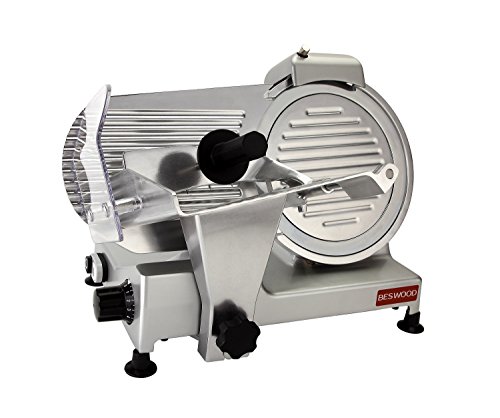
The BESWOOD250 occupies the step between a lightweight food slicer and a larger deli machine. Its listing identifies a 10-inch chromium-plated blade and 240W motor. The buying decision is whether that larger format earns its place on your counter through regular slicing, rather than whether a bigger blade looks more professional.
Residue and blade condition need different remedies
When a replacement machine becomes a reasonable question
What to send when requesting support
“The slicer is shredding everything” can describe several unrelated problems. Soft meat may compress into a smear; a roast cooked to fall apart may crumble; a loose holder may produce wedge-shaped slices. Those symptoms need different responses. Buying a blade or increasing pressure before identifying the symptom can waste money and make operation less controlled.
Stop first if the machine behaves abnormally
This troubleshooting sequence is for disappointing food output, not permission to continue using damaged equipment. If a blade appears damaged, a part is loose, the carriage binds, the appliance vibrates unexpectedly or the motor sounds strained, stop using it. Follow its instructions for making it safe and obtain the specified service help.
Never touch the edge to test sharpness, adjust a running mechanism or reach past guards to clear food. Do not remove a guard to improve your view of the problem. Observe the finished slice on a separate surface and inspect components only under the manufacturer’s safe maintenance procedure.
Name the failure before changing the setting
What you see
Question to investigate
First useful action
Surface dragged into a soft film
Is the food compressing or residue building up?
Pause and assess food condition and required cleaning
Separate chunks and loose fibers
Does the cooked meat itself fall apart?
Inspect a portion on a separate board
One side thick, the other very thin
Is the food sitting squarely and remaining supported?
Recheck holder use and presentation
Only the outer edge fragments
Is a crust or loose coating breaking off?
Distinguish exterior loss from central slice failure
Good first slices, worse later slices
What changed during the session?
Check food condition, remaining shape and residue
Problem across every suitable food
Is model-specific maintenance or service due?
Consult the manual and service provider
Write one sentence about the result rather than simply calling it bad. For example, “The center stays intact but the crust breaks off” is useful. “The slicer cannot cut meat” is too broad to guide a sensible correction. A photo of the finished output can help when contacting the manufacturer.
Check the food’s own structure
Move a portion to a separate board and consider how it behaves under normal handling. A braised roast that pulls into strands is structurally different from a cohesive deli block. If it already separates easily, an intact paper-thin sheet may be an unrealistic goal regardless of the slicer’s size.
Try a more substantial slice only within the documented operating range and only if the food is otherwise suitable. If it still collapses, choose a preparation that fits the texture: pulled or chopped meat may make a better filling. Do not use the appliance as a test of how much pressure can hold a fragile roast together.
For roast beef, grain orientation also affects the eating result. Long fibers in a thin sheet can feel stringy even when the cut itself is clean. The roast-beef preparation guide explains how to assess orientation away from the machine.
Ask whether the food condition changed
A long session can produce different results at the end than at the beginning. Compare the food’s condition, the size of the remaining piece and visible residue rather than immediately assuming the blade went dull within minutes. Keep food appropriately stored while you investigate.
Do not improvise a universal freezer treatment. The exact slicer may prohibit frozen food, and a hard outer layer can create a new problem even if the center remains soft. Follow the food restrictions and preparation instructions for that model. A title containing frozen meat is not enough detail to establish an allowed condition.
Also separate poor slicing texture from questionable food condition. If you have concerns about whether food was stored or handled safely, do not treat chilling or slicing as a remedy. This article diagnoses output; it cannot determine whether a particular piece of food is safe to consume.
Watch support as the piece gets smaller
A full block may sit securely while its final curved section starts to rock. If failure begins only near the end, the holder’s ability to control the remaining shape is a strong question to investigate. Follow the manual’s limits and stop before the remainder becomes unsuitable for the holder.
A repeated wedge pattern can arise when the food is angled rather than square to the gauge. Reposition only with the machine made safe as instructed. Do not try to counter the angle with more hand pressure near the blade. If a component itself moves or seems out of alignment, seek proper service rather than adjusting undocumented fasteners.
For broad bacon slabs, unsupported overhang creates another version of the same problem. That belongs in a capacity assessment. A motor upgrade cannot make an undersized carriage support food beyond its limits.
Change one variable at a time
Once food compatibility and machine condition are established, use a small sample to investigate. If the setting is extremely thin, try a modestly thicker permitted setting while keeping food orientation and the operating method consistent. Observe whether intactness improves. Do not change the food, blade, dial and feed technique simultaneously and then assume you know which helped.
Keep a brief record: food type, approximate portion shape, dial position and symptom. The thickness reference explains why dial numbers are model-specific. A successful setting on a friend’s slicer cannot be treated as a calibrated instruction for yours.
Reject the idea that speed or force is the universal answer. The manual defines appropriate operation. If the food only passes when pushed unusually hard, stop and investigate compatibility, size and equipment condition. Repeatedly forcing it through can turn a quality complaint into an equipment problem.
Residue and blade condition need different remedies
Food buildup requires the specified cleaning process. A worn or damaged cutting edge may require maintenance or replacement. These are not interchangeable actions: sharpening does not remove all food from inaccessible surfaces, and a clean blade is not necessarily in good mechanical condition.
FDA notes that wiping visible debris does not replace thorough cleaning and sanitizing in its commercial slicer guidance. If damaged seals or inaccessible buildup prevent proper cleaning, address that problem through the manufacturer rather than continuing to use the appliance.
Use only the maintenance method specified for the exact blade. Do not assume a serrated blade, a coated blade and a blade intended for a built-in sharpener can be treated alike. If instructions are missing, obtain them before experimenting with stones, abrasives or replacement parts.
When a replacement machine becomes a reasonable question
Consider replacement when the machine’s documented capacity or permitted foods do not match your normal job, or when proper repair is unavailable or impractical. Do not replace it merely because one unusually soft roast failed to make translucent slices. First show that the task is suitable and the limitation belongs to the equipment.
For a smaller home-format comparison, the Nutrichef B0CQMMKYHD and CUSIMAX B0C4YKDMDM offer different listed blade sizes and removable components. The BESWOOD250 B01AQH636Q represents a larger deli format to investigate. None is offered here as a proven cure for smearing; their relevance depends on the limitation you have identified.
Review those options in the deli slicer collection with a written requirement such as permitted food dimensions or accessible cleaning procedure. “Must stop shredding” is too vague for a productive comparison. “Must support my prepared roast face with the supplied holder” gives you something a manufacturer can answer.
What to send when requesting support
The exact model and any version information shown on its label.
The food type and condition, without assuming the manufacturer already knows your recipe.
The setting and whether the problem occurs immediately or later in the batch.
Photos of the finished slices and externally visible setup, taken with the appliance safely stopped.
The cleaning and maintenance steps already performed according to the manual.
Any abnormal noise, movement or binding that caused you to stop using it.
That evidence helps distinguish a food-preparation issue from a service issue without asking you to dismantle anything beyond the owner procedure. Resume use only once the relevant problem is resolved. A clear diagnosis is more valuable than repeatedly buying sharper-looking equipment.
Check the model against your decision
BESWOOD 250: Confirm the cutting envelope, assembled footprint, lifting weight, approved foods and cleaning procedure in the BESWOOD250 manual.
As an Amazon Associate, we may earn from qualifying purchases.