Choose around the dimensions and firmness of the boneless prosciutto you buy, then confirm the manufacturer’s food restrictions and thin-slice guidance. A dial marked zero and a large blade do not prove reliable translucent slices. Whole bone-in legs require a different preparation approach.
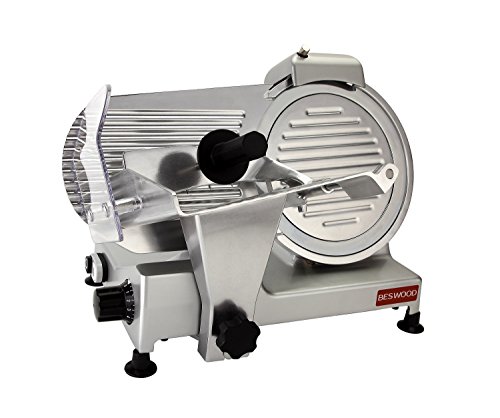
The BESWOOD250 occupies the step between a lightweight food slicer and a larger deli machine. Its listing identifies a 10-inch chromium-plated blade and 240W motor. The buying decision is whether that larger format earns its place on your counter through regular slicing, rather than whether a bigger blade looks more professional.
This 12-inch VEVOR listing advertises a 320W electric deli cutter. It belongs in a larger-machine comparison where the buyer has already measured product size and counter access. More blade diameter is useful only if the complete feed path accommodates the food you actually prepare.
This CUSIMAX listing distinguishes itself with two removable 8.7-inch blades and a removable food carriage. It advertises a 1–20mm adjustment range. The practical question is whether the food-contact components you must wash can be removed in a way you are comfortable repeating after each session.
Define the presentation before comparing the machinery
Boneless means more than removing the obvious bone
Why the lowest dial setting can be misleading
Three candidates, with different questions attached
Consider the receiving side of the slice
Ask about maintenance before judging long-term value
Decide whether intact full-face slices justify the footprint
Compare electric deli formats with the experience you expect
Plan the first acceptance check while returns are still practical
A purchase checklist for the supplier and the manufacturer
Prosciutto makes a demanding buying decision because an acceptable sandwich slice and a delicate charcuterie slice are not the same result. A machine may slice a firm deli loaf competently without producing the presentation you want from a broad, irregular piece of dry-cured ham. Begin with the product you actually buy: a small boneless block is a different equipment requirement from a full deboned leg.
Define the presentation before comparing the machinery
For folded pieces on a board, visual continuity and easy separation matter. For cooked applications, an intact translucent sheet may add little value. A pizza topping can tolerate smaller pieces that would be disappointing on a formal platter. Spending for a large slicing format makes sense only if the extra capacity and handling features address your serving goal.
Write down whether you need a complete cross-section, smaller folds or pieces for cooking. Also note how often you serve it. A person preparing occasional appetizers might be better served by buying freshly sliced portions, while someone who routinely buys boneless sections has a clearer reason to own suitable equipment. Purchase frequency is not proof of savings; it simply identifies whether the task repeats.
Boneless means more than removing the obvious bone
A domestic rotary food slicer is not a butcher’s saw. Do not load a bone-in leg, a product with an unknown hard core or a piece whose exterior the machine is not intended to cut. Deboning and trimming require separate appropriate preparation. Ask your supplier what is included in the specific item, since a photograph of packaged ham may not reveal its structure.
Once prepared, an irregular boneless section still needs stable support. A narrow end and a broad center can behave differently under the holder. Measure the largest face you intend to cut and confirm the machine can accommodate it with its normal guards and holder. Do not plan to hold a whole leg by hand because the narrow end happens to reach the blade.
Prosciutto format
Primary machine question
Reason to pause
Small boneless block
Can the holder grip it throughout the useful portion?
The block is too small or irregular for secure support
Broad deboned section
Does the full face fit the cutting envelope?
Only part of the face can travel past the blade
Whole bone-in leg
What separate preparation and equipment are required?
Assuming a rotary food slicer can process the bone
Very fine presentation slices
What documented control and food guidance support that aim?
Relying only on a zero mark on the dial
Why the lowest dial setting can be misleading
A gauge scale describes an adjustment, not guaranteed slice integrity for every food. The food can compress, the face can sit at a slight angle, and the holder can shift as the piece changes shape. At very thin settings those differences become more visible. A beautiful sample in advertising does not establish how reliably you will reproduce it with your own ham.
Look for model-specific documentation and a clear explanation of the controls. Ask the manufacturer about your actual cured-meat format rather than asking whether the machine cuts thin. If the answer is only a general minimum setting with no food or capacity detail, treat the achievable presentation as unresolved.
It is also useful to distinguish slice thickness from slice size. A small, consistently thin piece may be excellent on a canapé. If your goal is a full-width drape from a large leg, that same machine may disappoint because of geometry, not because it cannot cut finely. The thickness chart addresses texture; the food dimensions determine the shape.
Three candidates, with different questions attached
The BESWOOD250, ASIN B01AQH636Q, is listed as a ten-inch electric deli slicer with a chromium-plated steel blade. It is a useful candidate when you want a dedicated deli format and can accommodate it. Check the exact manual for the prepared ham you use and do not treat the broad meat-and-cheese title as a guarantee of competition-level charcuterie presentation.
The VEVOR twelve-inch listing, ASIN B0GSYXKNX9, gives a twelve-inch blade and 320W rating. Consider investigating it when the food face is the limiting factor in smaller options. Its title does not by itself confirm maximum prosciutto dimensions, the suitability of an irregular deboned leg or repeatable sub-millimeter performance. Request the dimensions that matter before ordering.
The CUSIMAX candidate, ASIN B0C4YKDMDM, lists two removable 8.7-inch blades and a 1–20 mm range. It may enter a comparison for smaller prepared sections and general home deli work. If your non-negotiable goal lies below the stated range, do not assume the knob travels farther than the documentation says. A product that is suitable for sandwiches can still be the wrong answer for your presentation target.
These are alternatives from the deli slicer collection, selected for investigation by format. We have not run a comparative prosciutto test, and no ranking here claims a measured advantage in slice quality.
Consider the receiving side of the slice
A delicate slice can be cut successfully and then ruined by piling it into a cramped receiving area. Before buying, look at where the output lands and whether your collection arrangement works without reaching near the blade. A large machine in a narrow corner can offer worse practical access than a smaller machine on an open bench.
Plan a pause-and-transfer workflow. Stop as required to move the finished pieces to a serving surface away from the mechanism, using appropriate utensils. Do not reach behind a running blade to rescue a folded slice. If perfect separation requires constant intervention near the cutting area, the arrangement needs redesigning.
Think about the plate you are filling, too. You may prefer to slice small batches as you assemble rather than producing a high stack first. The relevant equipment benefit then becomes controlled starts, manageable food support and accessible output, not maximum claimed throughput.
Ask about maintenance before judging long-term value
Fine slicing leaves less tolerance for a neglected cutting edge or poorly maintained carriage. Identify the exact replacement blade, the maintenance procedure and which tasks belong to service personnel. A built-in sharpener should not be used by habit whenever a slice tears; food preparation and support can also cause tearing.
Check whether the manual explains the removal and reinstallation of components you must clean. The appliance should be feasible to maintain in your own kitchen, including room to set down the removed parts safely. Do not assume every part described as stainless is dishwasher safe, or that a spray rinse is appropriate for an electric base.
FDA’s slicer sanitation guidance highlights hidden accumulation around guards and handles. Apply the relevant manufacturer procedure rather than judging cleanliness from the visible cutting face alone.
Decide whether intact full-face slices justify the footprint
Imagine two households buying the same cured ham. One uses short folded pieces for six appetizers; the other expects broad, nearly transparent slices every weekend. The first can consider smaller boneless portions and possibly avoid owning a machine at all. The second should demand stronger evidence about capacity and fine adjustment before choosing a larger deli format.
The question is not whether the largest slicer is inherently better. It is whether the small option fails a specific requirement you care about, and whether the larger candidate documents a solution. If both can support your portion, cleaning effort and storage may decide the purchase more than blade diameter.
Compare electric deli formats with the experience you expect
People sometimes picture a traditional hand-operated flywheel slicer when they imagine preparing prosciutto, then shop among compact electric food slicers. These are different operating experiences. Our current candidates here are electric formats; their presence in a deli collection is not a claim that they reproduce the appearance, handling or presentation associated with every specialty slicer.
Identify what you actually value about the demonstration that inspired the purchase. Was it the size of the ham, the uninterrupted slice, the controlled motion or simply the way the finished food was plated? Only some of those outcomes are equipment specifications. Attractive plating can be done away from the machine, while a large food face requires real capacity. Keeping those goals separate prevents buying an oversized appliance to solve a presentation issue.
Plan the first acceptance check while returns are still practical
Before ordering, read the seller’s actual return terms, particularly any conditions concerning food-contact equipment. Do not assume an opened or used machine can be returned merely because a different retailer allows it. Retain the model documentation and inspect the received configuration before bringing food into the test.
Check that the delivered model matches the ordered version, that the supplied holder and guards are present, and that the manual is understandable. If the dimensions or components do not match what was represented, resolve that discrepancy with the seller before use. Do not modify the machine to make an incorrect purchase fit the food.
For an initial permitted food trial, define success in ordinary terms: the prepared portion fits, remains supported, and yields a small group of useful slices at an allowed setting. Do not turn the first session into a hunt for the thinnest physically possible fragment. If your intended presentation is not attainable under normal instructed operation, document what happens and seek model-specific guidance.
This approach also protects against confusing a portion problem with a purchase failure. An unusually narrow heel cannot demonstrate how the machine handles a normal block, while an oversized whole section cannot fairly test equipment that expressly requires smaller food. Start with a representative portion inside the published limits, and keep your expectation tied to the serving goal you established.
A purchase checklist for the supplier and the manufacturer
Confirm the ham is boneless and identify any preparation still needed.
Measure its maximum cutting face and the usable gripping section.
State the presentation you expect: cooking pieces, sandwich layers or delicate full-face slices.
Ask for the exact model manual and permitted food conditions.
Check operating clearance and where finished slices will collect.
Identify parts support and the cleaning procedure before buying.
For softer cooked meats, the priorities shift toward moisture and structural support; see thin roast-beef preparation. For a long fatty rectangle, bacon slab sizing addresses a different capacity problem. Use those distinctions to keep one appliance purchase aligned with the food you prepare most often.
Check the model against your decision
CUSIMAX 8.7-inch two-blade slicer: Verify each blade's edge type, the model number on the current offer, duty cycle and approved cleaning method.
As an Amazon Associate, we may earn from qualifying purchases.