Ham often presents a rounded or formed block, while bacon presents a long slab with alternating fat and lean. The same slicer may handle both only when each fits and the manual permits its condition. Treat raw bacon and ready-to-eat ham as separate food-handling tasks, not a continuous interchangeable batch.
This CUSIMAX listing distinguishes itself with two removable 8.7-inch blades and a removable food carriage. It advertises a 1–20mm adjustment range. The practical question is whether the food-contact components you must wash can be removed in a way you are comfortable repeating after each session.
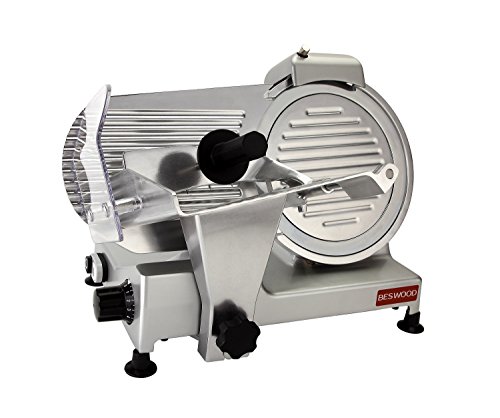
The BESWOOD250 occupies the step between a lightweight food slicer and a larger deli machine. Its listing identifies a 10-inch chromium-plated blade and 240W motor. The buying decision is whether that larger format earns its place on your counter through regular slicing, rather than whether a bigger blade looks more professional.
The VEVOR 10-inch 240W listing describes a chromium-plated blade and semi-automatic operation. It is a candidate for buyers comparing the larger circular-blade format with BESWOOD250, but similar dimensions in the title do not make their service support, carriage travel or permitted foods identical.
Geometry explains many apparent performance differences
The thickness dial should follow the meal
How moisture and fat affect your observations
What one machine must document to serve both jobs
Three catalog formats worth comparing
Plan two jobs even if you use one appliance
When separate buying formats are more sensible
The words ham and bacon describe broad groups of products, not two uniform blocks of meat. A fully cooked deli ham, a dry-cured ham and a raw cook-before-eating ham can have very different handling requirements. Bacon can arrive as a long belly slab, a compact piece or a different style entirely. Read the product description and preparation instructions before deciding how to use a slicer.
The comparison begins with the label
Determine whether each food is ready to eat or still requires cooking. Do not infer that status from smoking, curing, color or a familiar name. A slicer is a cutting tool; it does not change the food’s preparation requirements. Keep the package information available until portions are labeled.
A ready-to-eat ham destined for a cold sandwich creates a different workflow from bacon that will be cooked later. FoodSafety.gov advises separating raw and cooked foods and their utensils. Its clean and separate guidance should inform the sequence, alongside the appliance’s complete cleaning instructions.
Geometry explains many apparent performance differences
Variable
Typical deli-ham challenge
Typical belly-bacon challenge
Overall shape
Rounded or irregular block may rotate
Long rectangle may exceed carriage travel
Support
Holder must restrain the changing curved surface
Whole slab must stay supported across its length
Structure
Moist or loosely bound sections may tear
Fat and lean layers may deform differently
Serving goal
Intact sandwich layers or thicker dinner pieces
Strips intended for subsequent cooking
End portion
Curved heel can become hard to grip
Narrow remainder may lose stable support
These are common shapes to assess, not promises about every product sold under either name. For an unusual cut, measure and inspect it directly. A small square ham may be easier to support than a large rounded one; a short piece of bacon may fit where a whole slab does not.
Suppose a machine takes your ham comfortably but leaves several inches of bacon unsupported. That does not necessarily mean its blade lacks power. It means the slab’s geometry does not match the usable bed. Divide the bacon appropriately away from the slicer if shorter strips meet your needs, or use a machine with documented capacity for the full face.
The thickness dial should follow the meal
A cold ham sandwich often benefits from several flexible layers. Bacon may need a more substantial raw strip to produce the preferred cooked texture. Copying the ham setting to the bacon simply because both foods are pork ignores what happens next in the kitchen.
Compare a small amount of each at its intended serving stage. Taste ham in the actual sandwich and assess bacon after its prescribed cooking process. Keep the portion sizes comparable when evaluating thickness. The thickness guide provides suggested starting ranges without claiming an official ham or bacon standard.
If a thin ham slice collapses into fragments, a modest increase may produce a better layer. If a bacon strip is too delicate to separate or handle, a different setting may serve the recipe better. Neither observation proves the machine is faulty; the useful output is defined by the food and meal.
How moisture and fat affect your observations
With a moist ham, watch for compression, surface dragging and pieces that adhere to one another. With a bacon slab, look for lean and fat separating at their natural boundaries or one layer deforming more than another. Describe the symptom precisely before changing equipment.
A cooked ham that is structurally loose may break even when the blade makes a clean cut. Bacon with a soft outer layer may distort against the plate before the cutting edge reaches it. Repeatedly increasing feed pressure can hide the cause and worsen the result. Pause, assess the food condition allowed by the manual and check support.
Do not adopt a universal rule to freeze both foods before slicing. Manufacturers differ in what they permit, and food forms differ in how they respond. If the model excludes frozen food, follow that restriction. The preparation question is about the exact appliance and food, not a generic online trick.
What one machine must document to serve both jobs
First, both prepared foods need to fit the stated cutting envelope. Second, the supplied holder must control each shape. Third, the permitted food conditions must cover both tasks. Finally, the cleaning and operating routine must work for the way you alternate between them. A general “meat slicer” title does not answer all four.
Use the slab-capacity checklist for the bacon side of the purchase. For cooked roast-like foods whose fibers or structure are the problem, the roast-beef guide explains support and orientation. Neither should be replaced by a claim that more motor watts solve every difference.
Three catalog formats worth comparing
The CUSIMAX B0C4YKDMDM lists removable 8.7-inch blades, a removable carriage and a 1–20 mm range. It is a comparison candidate when the foods are portioned for home use and you want to investigate cleaning access. Confirm which supplied blade the manufacturer specifies for each food.
The BESWOOD250 B01AQH636Q is listed as a ten-inch deli machine. It may enter the shortlist when you want a dedicated appliance for repeated ham and bacon preparation, subject to dimensions and manual approval. Do not assume the commercial wording proves unlimited duty or full-slab fit.
The VEVOR ten-inch B08R7JJF3R includes frozen meat and deli slicing in its catalog title. That wording makes the exact food-condition instructions especially important to obtain. It does not authorize arbitrary hard-frozen slabs or establish equivalence with the other models. Compare their documentation through the deli and bacon collection, where the intended tasks can be considered together.
Plan two jobs even if you use one appliance
Make a separate output container and label plan for each food. Do not put ready-to-eat slices on a tray that just held a product requiring cooking. Account for the necessary cleaning transition in your session time rather than treating it as an inconvenience to skip.
Labels should preserve whether the product requires cooking and the original relevant dates. A bag of bacon pieces and a bag of ham pieces can look similar after portioning; relying on memory creates unnecessary confusion. Distinct containers also keep recipes and household use easier to manage.
For a commercial operation, the applicable food code and approved sanitation procedure govern the work. At home, follow the manufacturer’s cleaning instructions and appropriate food-handling guidance. A brief wipe between visibly different foods is not a substitute for the required process.
When separate buying formats are more sensible
You might buy a compact ham that suits weekly sandwiches but purchase bacon already sliced because full-length strips exceed your appliance. That is a reasonable mixed solution. Owning a slicer does not require processing every food in the same format, and a larger machine may not be justified by one occasional slab.
Alternatively, if bacon is the main recurring task, choose around the slab and then check whether your ham fits the same machine. Avoid selecting for an easy small ham first and discovering that the food you most wanted to slice requires compromises you dislike.
The decisive comparison is therefore between your two real jobs: exact food format, desired output, documented compatibility and complete cleaning workload. Use those details to select the appliance, then develop separate settings for each food instead of searching for one universal pork-slicing setting.
Check the model against your decision
VEVOR 10-inch 240W slicer: Resolve the precise VEVOR model, permitted food state, duty cycle and business-use requirements.
As an Amazon Associate, we may earn from qualifying purchases.