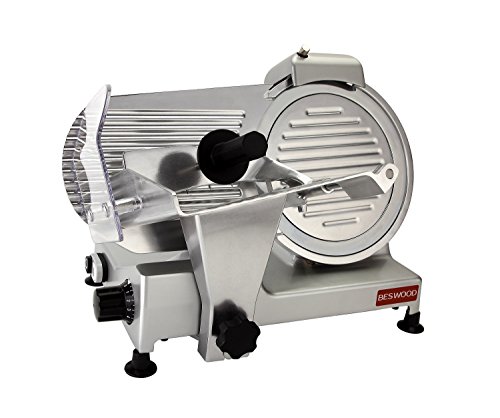
Compare an electric slicer with a guided jerky board using batch size, preparation time, repeatability, storage, and full cleanup—not blade speed alone.
A guided board is often the simpler choice for occasional manageable batches. An electric slicer becomes worth investigating when repeated thickness cuts dominate the work and its instructions permit your meat preparation. Compare total session time, including dismantling and cleanup, rather than cutting speed alone.
The Hi Mountain kit combines a knife and meat-slicing board. It belongs in the comparison for smaller batches where a guided manual cut may be easier to store than a powered machine. The quality of the result still depends on controlled knife work and the kit's actual thickness geometry.
The BESWOOD250 occupies the step between a lightweight food slicer and a larger deli machine. Its listing identifies a 10-inch chromium-plated blade and 240W motor. The buying decision is whether that larger format earns its place on your counter through regular slicing, rather than whether a bigger blade looks more professional.
LEM's BigBite 10-inch electric slicer is cataloged as a home-use appliance. Its appeal for a shortlist is the combination of a named product family and a larger blade than compact domestic machines. Jerky suitability still depends on the manual's permitted food state and the size of the prepared cut.
Compare ownership effort as well as a single batch
Decide with a three-session notebook
The electric machine looks faster because the blade moves continuously. The board looks simpler because it has fewer mechanisms. Neither impression answers the useful question: which produces your required pieces with less total work in your kitchen?
This comparison concerns a guided knife board and a circular electric slicer. A crank-operated strip cutter is a third format, discussed where it changes the decision. We have not timed these products side by side, so the worked example below is explicitly a planning illustration, not a performance test.
Start with the task both tools must finish
Define the endpoint as suitable raw pieces ready for the next step in your selected jerky method. That endpoint may require trimming, broad slicing, and dividing sheets into strips. Counting only the moment a blade contacts meat favors whichever tool moves work outside the stopwatch.
A circular machine may create repeatable sheets efficiently while leaving a separate strip-cutting operation. A guided board may require more knife strokes but allow you to trim and orient an awkward piece without moving to another station. Those differences matter when the batch contains mixed shapes rather than one ideal roast.
Keep the preservation method fixed while comparing tools. The NCHFP jerky instructions provide one authoritative reference. Equipment should support the required preparation; a convenient adjustment range should not dictate an improvised recipe.
The comparison that determines daily convenience
Question
Guided board
Electric circular slicer
How is thickness established?
Guide geometry plus knife movement
Gauge adjustment plus food support and feed
What preparation may remain?
Trimming and later strip division
Trimming, fitting the carriage, and later strip division
What needs storage space?
Board, knife, guides, and accessories
Whole appliance plus removed components
What requires documentation?
Safe holding, guide settings, and cleaning
Permitted foods, operating limits, assembly, and cleaning
What can change the result?
Food movement and knife path
Food movement, feed technique, and machine condition
The table does not declare a universal advantage in precision. Either format can produce unsuitable output if the food shifts or the settings are misunderstood. Compare your actual acceptable pieces, not the neatness of a product photograph.
Illustrative break-even calculation
Assume, solely for illustration, that setting up and cleaning a board takes 8 minutes and the cutting stage takes 4 minutes per pound. Assume a permitted electric setup takes 20 minutes before and after the cutting, while its cutting stage takes 1.5 minutes per pound. These numbers are invented planning inputs, not measured times for any listed product.
For a batch weighing B pounds, the board session is 8 + 4B minutes and the electric session is 20 + 1.5B minutes. Setting them equal gives 2.5B = 12, or B = 4.8 pounds. Under these assumptions, the crossover occurs near five pounds.
Illustrative batch
Board calculation
Electric calculation
2 pounds
8 + 8 = 16 minutes
20 + 3 = 23 minutes
5 pounds
8 + 20 = 28 minutes
20 + 7.5 = 27.5 minutes
10 pounds
8 + 40 = 48 minutes
20 + 15 = 35 minutes
Replace every input with your own observations before using the result. Add any second-stage strip cutting that differs between the methods. If you must carry the machine from a cupboard, count that handling. If the board needs multiple passes to produce acceptable slices, count those too.
The crossover can disappear entirely. When electric cleanup is awkward or batches are small, the faster cutting stage may never offset the fixed work. Conversely, a permanently installed machine used for several permitted foods may justify itself without jerky alone carrying the purchase. That is a broader household decision, covered in whether a slicer is worth owning.
What a board buys you
A board keeps the preparation visible. You can examine the grain, divide an irregular section, and check a sample before continuing. For someone learning whole-muscle jerky, that visibility can make it easier to understand which step changes the output.
The tradeoff is repeated controlled knife movement. Consider your comfort with the supplied knife and holding method rather than assuming a nonpowered tool requires little effort. A guide still needs correct technique. If the work causes you to rush or lose control, the theoretical simplicity has not translated into a suitable setup.
The Hi Mountain kit, ASIN B07QKP62HZ, supplies a named board-and-knife option for this comparison. Check the current listing and instructions for the actual dimensions, included components, and intended cutting method. No adjustable spacer range is established by the catalog title. Assess whether the complete kit supports your normal pieces and recipe preparation rather than assuming that every guided board works alike.
A board is also worth considering if you lack a practical place to clean a heavier appliance. Measure the board against your sink and drying area before buying. Storage dimensions alone do not tell you whether the whole work cycle fits.
What an electric machine buys you
An electric blade removes the need to supply the cutting motion through a knife stroke. You still control food presentation and the carriage according to the manual. The potential benefit is repeated slicing after setup, particularly when many similarly prepared pieces require the same thickness.
That potential depends on permitted use. A listing that mentions deli food or cheese does not by itself establish suitability for every raw-meat condition. Confirm the specific manual before placing raw jerky preparation on the shortlist. Do not use motor power as a substitute for this check.
BESWOOD250, ASIN B01AQH636Q, is one catalog example of a 10-inch electric format. LEM BigBite 10-inch, ASIN B005QJJREK, offers another named option to investigate. Compare the documents for carriage capacity, operating limits, and permitted foods. This page does not claim one delivers more precise slices or a higher real-world yield.
Make space for the complete carriage travel and the receiving container. An appliance that fits tightly between two objects while idle may not have a usable operating footprint. Likewise, a storage shelf that accepts the housing may not make repeated lifting convenient. The counter-space planning guide addresses that distinction.
When neither is the missing tool
If you already produce satisfactory slabs but lose time dividing them into strips, examine a dedicated strip cutter. The Weston manual unit, ASIN B001SGB3SS, belongs to that discussion. Its role should be assessed from input to output rather than treated as a smaller circular slicer.
This can be a complementary purchase instead of a replacement. A preparation sequence might use one tool to establish a slab and another to divide it. Whether that is worthwhile depends on the additional setup, washing, storage, and handling. Two fast individual operations can still make a cumbersome household routine.
Before adding a second device, observe where the time goes during one ordinary batch. If most time is spent trimming unsuitable pieces, a strip cutter will not remove that work. If most time is spent loading trays, faster cutting may produce a larger queue and no earlier finish.
Repeatability should be measured at the food
Check an early, middle, and late piece, particularly after changing the input section. The slice-thickness guide explains what to record. You are looking for the actual output range rather than trusting a dial, a guide marking, or a seller’s use of the word uniform.
A useful comparison also records rejected pieces. If a method produces twenty pieces quickly but five do not suit the planned preparation, its useful output is fifteen. Avoid claiming a better yield until you have measured comparable input and acceptable output over more than one session.
Track why a piece is unsuitable: excessive thickness, taper, tearing, or an awkward final remnant. Those categories point to different improvements. A different guide may solve a height problem, while a better-prepared input may solve support problems without any purchase.
Compare ownership effort as well as a single batch
A tool can win a one-session timing comparison and still be inconvenient to own. Count how often you will retrieve it, where it will live between sessions, and whether anyone else needs the same counter. A permanently reserved location has a different cost in a small kitchen than on a dedicated preparation bench.
Also consider how you will identify and replace the part that wears first. For a kit, that may involve a particular knife or guide component. For a powered machine, it may involve an approved blade or another model-specific part. Do not buy a generic replacement in advance just because its nominal size matches; confirm compatibility when the need is clear.
There is a learning burden too. If you already use a board consistently, the first few sessions with a new machine may include extra reading and setup checks. That does not prove the purchase was poor, but it means the advertised operation is not the entire transition. Reserve time to understand the new procedure before preparing a large batch around it.
For a household sharing equipment, make the storage arrangement understandable to the next user. Keep guides together, preserve the manual, and avoid leaving a partly assembled appliance appearing ready to operate. A simple system that everyone can correctly identify may be more valuable than a feature that only one person remembers how to configure.
For example, a powered slicer that saves cutting time but cannot be lifted comfortably from its storage shelf creates a problem before every session. A board that fits the shelf but not the sink creates one afterward. Walk through retrieval, setup, cutting, cleaning, and return with the documented dimensions before using the timing example to justify a purchase.
If both formats satisfy the essentials, choose based on the work you repeatedly dislike. Repeated knife strokes point toward investigating powered cutting. Repeated appliance dismantling points toward examining a simpler preparation format. Keep that preference explicit instead of calling either one universally easier.
Decide with a three-session notebook
For three normal sessions, record batch weight, number of separate pieces, setup time, cutting time, second-stage work, cleanup time, and the main frustration. Include the tasks you are tempted to omit because they occur before slicing, such as retrieving equipment and arranging a drying area.
You do not need a laboratory protocol. You do need enough consistency that one unusually difficult cut does not define your purchase. Write down interruptions separately so a phone call is not counted as evidence that a tool is slow.
If knife work repeatedly dominates and the pieces suit a documented electric application, investigate the machine. If cleanup and storage dominate, a simpler guided board may be the more useful answer. If both are minor compared with trimming or tray handling, keep the existing tool and improve the surrounding workflow first.
Use the jerky collection for the product shortlist and the batch workflow for organizing the entire preparation. Buy the equipment that removes a measured obstacle, not the one whose blade looks busiest.
Check the model against your decision
Weston 07-3801-W-A jerky slicer: Confirm the strip width, assembly, mounting and blade-comb cleaning instructions for 07-3801-W-A.
As an Amazon Associate, we may earn from qualifying purchases.
Weston's manual jerky slicer lists an input opening for cuts up to 5 inches wide and 1.25 inches thick. This is an important distinction from a deli slicer: its blade arrangement creates strips from prepared meat, rather than making it a universal substitute for an adjustable circular-blade machine.