Match a jerky slicer to the cuts you buy, the thickness you need, and the cleanup you will actually do. Compare boards, strip cutters, and electric slicers.
Start with the shape you need to produce: thin slabs, narrow strips, or both. A thickness-adjustable slicer, a slicing board, and a hand-crank strip cutter are not interchangeable. Choose the machine only after checking its permitted foods, usable feed dimensions, and cleaning instructions.
Weston's manual jerky slicer lists an input opening for cuts up to 5 inches wide and 1.25 inches thick. This is an important distinction from a deli slicer: its blade arrangement creates strips from prepared meat, rather than making it a universal substitute for an adjustable circular-blade machine.
This Paladin listing combines manual jerky slicing and tenderizing in one product. Its value depends on whether both processes belong in your kitchen; tenderizing and producing uniform strips are different operations and should not be presented as interchangeable results.
The Hi Mountain kit combines a knife and meat-slicing board. It belongs in the comparison for smaller batches where a guided manual cut may be easier to store than a powered machine. The quality of the result still depends on controlled knife work and the kit's actual thickness geometry.
Use the current catalog as a shortlist, not proof of suitability
Compare useful capacity, not just blade diameter
Calculate the batch you really make
Cleanup is a purchasing specification
Reject misleading shortcuts
A purchase worksheet you can complete before checkout
Your final purchase test
A shopper searching for a jerky slicer can encounter three quite different machines. One turns a roast into broad slices. Another divides an already prepared piece into multiple narrow strips. A third guides a knife at a chosen height. Each may be useful, but buying the wrong one can leave the most time-consuming step untouched.
The practical question is not which has the biggest motor. It is where your preparation currently slows down. If you struggle to make evenly thick slabs, a strip cutter will not necessarily solve that problem. If slabs are already prepared and you spend your afternoon cutting them into ribbons, a large circular blade may add little. The jerky equipment collection groups these options together so you can compare their roles.
Sketch the meat before choosing the machine
Take the cut you normally buy and write down its length, width, and height after trimming. Then sketch the finished raw strip. Label all three dimensions. This small exercise avoids the most common misunderstanding in jerky equipment descriptions: calling both thickness and width the size of a slice.
Suppose a prepared piece measures 8 inches long, 4 inches wide, and 1 inch thick. A circular slicer might remove sheets from one face according to its thickness setting, provided the exact model permits that food and the carriage supports it. A multi-blade strip cutter instead works according to its blade arrangement and feed path. Neither description alone tells you the dimensions of the final strip. Follow the piece through the machine in your sketch before ordering.
Do the same for grain direction. Rotating a piece to fit a feed opening can change the relationship between the cut and the muscle fibers. Equipment that accommodates your preferred orientation may be worth more than a modest increase in advertised capacity. Our grain-direction guide explains that choice separately.
Three approaches, three different advantages
Approach
Problem it addresses
What remains for you
Knife and guided board
Keeping a knife at a repeatable height
Trim, orient, support, and move the knife consistently
Hand-crank strip cutter
Dividing suitable prepared pieces into parallel strips
Prepare input dimensions and confirm resulting strip cross-section
Electric circular slicer
Producing repeated broad slices at an adjustable setting
Confirm raw-meat permission and cut sheets into strips if needed
A board makes sense when an occasional batch contains several awkwardly shaped pieces. You can examine each one before cutting, and storage is usually simpler than finding a permanent appliance location. The cost is repeated knife work. A powered slicer becomes attractive when the repeated thickness cuts dominate your task and the pieces suit its carriage.
A crank machine is a distinct candidate when you want a strip-making operation. Do not compare its advertised output directly with circular-slicer throughput without knowing the input preparation each requires. A fast second step can coexist with a slow first step. The slicer-versus-board comparison includes an illustrative whole-session calculation.
Use the current catalog as a shortlist, not proof of suitability
The Weston 07-3801-W-A, ASIN B001SGB3SS, is listed as a manual beef jerky slicer accepting cuts up to 5 inches wide and 1.25 inches thick. Those are input limits in the supplied title, not a statement that a finished jerky strip should have those dimensions. Check the current manual for blade arrangement, allowed preparation, and assembly before choosing it.
Paladin's 2-in-1 tenderizer and jerky slicer, ASIN B092XJ3RPW, offers a different comparison: whether one device can cover the two jobs you actually perform. The catalog title establishes those advertised functions; it does not establish the exact installed blade set, output geometry, or cleaning procedure. Ask those questions explicitly, because changing cutting assemblies can become part of every session.
The Hi Mountain slicing kit, ASIN B07QKP62HZ, represents the guided-knife option in this shortlist. Its catalog title identifies a knife and meat-slicing board, but the usable dimensions and intended cutting arrangement need checking in the current instructions. Match the complete kit to the preparation required by your recipe rather than assuming a board supports every thickness. Check the included knife, its replacement options, and the food-holding method before deciding whether the format suits you.
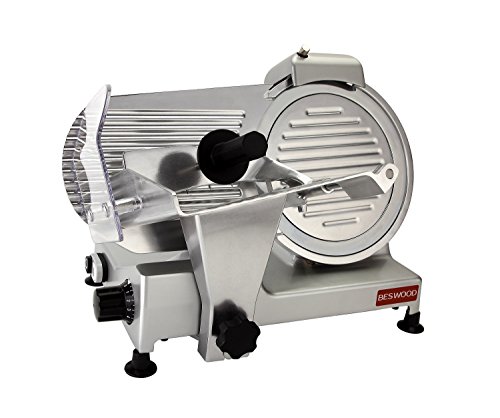
For broader slicing, the catalog includes BESWOOD250, ASIN B01AQH636Q. Its title identifies a 10-inch blade and 240W rating. That does not establish every permissible raw-meat condition or how large your roast can be. Keep it on a conditional shortlist until the exact instructions confirm the proposed jerky preparation. This is documentary selection advice, not a hands-on performance ranking.
Compare useful capacity, not just blade diameter
A circular blade's diameter is not the maximum width of every cut it can safely handle. The carriage, pusher, travel, guard, and food position jointly determine useful capacity. A roast that nominally fits beside a blade may still be awkward to support through the entire stroke. Check the manufacturer's stated cutting envelope rather than subtracting a guessed allowance from the blade diameter.
For a clamp-mounted cutter, measure the counter edge as carefully as the food. A decorative overhang, rounded profile, drawer front, or shallow apron can affect whether the clamp seats as intended. Do not assume a countertop that looks thick is solid through the clamp area. The manufacturer should specify allowable mounting arrangements; an improvised grip is not an upgrade.
For a board, the critical measurement can be usable support length. If the meat overhangs, you may keep repositioning it, which erodes the advantage of the guide. A longer knife is not automatically a cure because the guiding system may be designed around a particular blade. Compare complete systems rather than adding unrelated accessories to an assumed fit.
Calculate the batch you really make
Write a realistic session description: four trimmed pieces, one recipe, one loading of the dehydrator, and cleanup before lunch, for example. Avoid buying for a hypothetical annual marathon unless that event genuinely governs your needs. A machine sized for the exception may be cumbersome for the ordinary task.
Now identify the slowest stage. Preparation, slicing, strip separation, tray loading, heating, drying, and cleanup have different constraints. A larger slicer does not increase dehydrator space. If your drying equipment accepts only half the sliced batch, you also need a documented storage plan for the remainder. Buying cutting capacity without downstream capacity can simply move the waiting time.
You can compare equipment with a simple personal worksheet: session minutes equal setup plus preparation plus cutting plus sorting plus cleanup. Record each category separately over a normal session. These are your observations, not a manufacturer's pounds-per-hour claim. If cutting occupies only eight minutes of a forty-minute job, even a theoretical zero-minute cut could save no more than eight minutes.
Cleanup is a purchasing specification
Before ordering, find the dismantling instructions and count the parts you must remove after raw-meat use. Check where those parts will be washed and dried. A crowded sink can turn an otherwise straightforward assembly into an awkward handling task. Also check whether the manufacturer permits dishwasher cleaning; stainless steel in the title is not permission for every component.
FDA highlights hidden food accumulation and damaged seals as concerns on commercial deli slicers. The relevant buying lesson is to inspect cleaning access and support availability, not merely the shine of the housing. Read the FDA slicer guidance and obtain the model-specific procedure.
Check availability of the particular wearing parts before they become urgent. A replacement assembly that is easy to name and order is more useful than a vague promise of spare blades. Keep the model designation, parts diagram, and seller details with your records. Avoid choosing a machine whose basic manual cannot be located.
Reject misleading shortcuts
A high wattage is not evidence of continuous operation, permission to cut frozen blocks, or superior thickness consistency. A product described as commercial is not automatically appropriate for a licensed food business. A listed minimum thickness is not a guarantee that soft food will hold that dimension. Each claim belongs to a different question and requires its own evidence.
Likewise, the slicer is not a food-preservation process. The National Center for Home Food Preservation jerky method connects preparation to an actual preservation procedure. Pick that procedure before selecting settings; do not design a safety process around a convenient dial position.
A purchase worksheet you can complete before checkout
Make a row for each shortlisted product and five columns: input preparation, dimension controlled, complete equipment needed, cleaning access, and unresolved questions. Fill each cell from the exact listing or instructions. Leave unknown cells visibly unknown rather than awarding the product an optimistic score.
For a board kit, the input-preparation cell might say that your piece must fit the usable board and the supplied holding method. The dimension-controlled cell should state the documented guide height, not an estimate from the photograph. Under complete equipment, list the documented knife and required holding components. Under cleaning, record the approved method for each component.
For a grinder attachment, complete equipment is especially important. Write the actual host model and the required connector identity. If you cannot complete that entry with manufacturer confirmation, the product has not passed your fit check, regardless of how attractive its price appears.
For an electric circular machine, keep food permission and operating limits in separate cells. A machine can be suitable for a food yet require a work-rest routine that does not suit your planned session. Conversely, a long advertised running capability cannot establish that a particular raw input is permitted.
Use the worksheet to eliminate a product when one essential condition fails. Do not average away a failed condition with several attractive features. A machine that cannot fit your counter mounting, cannot support the food, or lacks required compatibility does not become suitable because it offers another blade.
Finally, save the exact model, ASIN, and documents used for the decision. Listings can present variants together, and a photograph of a nearby model is easy to misremember. The purchase should match the equipment you evaluated, including the current package contents. Recheck those details at the destination before placing an order.
Your final purchase test
Describe the entire route in one sentence: this piece, in this permitted condition, held this way, produces this shape, then goes into this documented recipe. If one phrase is still a guess, resolve it before buying. That is more useful than declaring one device best for every jerky maker.
Choose a guided board when manageable occasional batches and storage simplicity matter most. Investigate a strip cutter when parallel strip production is the genuine bottleneck. Investigate an electric machine when repeated sheet thickness is the challenge and the manufacturer's instructions support your food. Then use the thickness-checking method to verify what the chosen setup actually produces.
Check the model against your decision
BESWOOD 250: Confirm the cutting envelope, assembled footprint, lifting weight, approved foods and cleaning procedure in the BESWOOD250 manual.
As an Amazon Associate, we may earn from qualifying purchases.
The BESWOOD250 occupies the step between a lightweight food slicer and a larger deli machine. Its listing identifies a 10-inch chromium-plated blade and 240W motor. The buying decision is whether that larger format earns its place on your counter through regular slicing, rather than whether a bigger blade looks more professional.