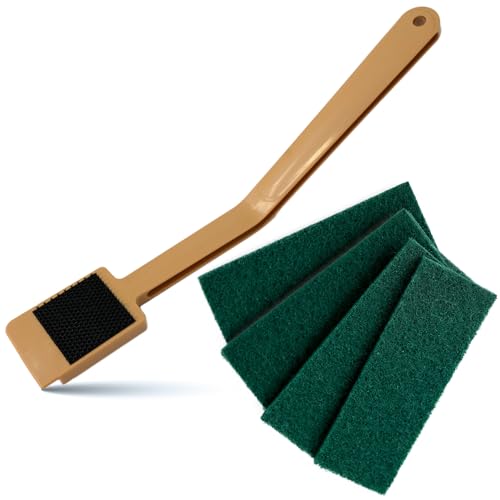
Buy supplies only after checking the slicer manual and product labels. Separate detergent, sanitizer, application tools and any required test strips. A slicer cleaning tool is useful only where the manufacturer permits its use; it does not replace safe disassembly or a complete cleaning process.
The EZ Scrub listing supplies a slicer-cleaning tool with four replacement pads. A purpose-shaped cleaning aid can be relevant where the manufacturer permits it, but it is not a disinfectant and cannot replace disassembly, washing or sanitizing steps required by the machine instructions.
Read the sanitizer label as a set of operating conditions
Evaluate a cleaning tool by the surface it reaches
Plan clean storage for the supplies themselves
Keep lubricant out of the cleaning decision
Calculate the useful purchase, not the biggest bundle
What the kit cannot repair
Use a short label worksheet before checkout
A large cleaning bundle can contain plenty of items and still miss the one your slicer needs. A brush intended for a grinder tube may not reach a slicer’s approved cleaning surfaces. A strong household disinfectant may have the wrong food-contact instructions. A bottle described as food grade may be a lubricant rather than a cleaner.
Build the kit from the task outward. Identify what the operator manual allows, then choose products whose labels support that use. Our care and parts collection separates documented needs from unrelated kitchen-cleaning accessories.
Four different jobs, four different questions
Job
Purchase question
Do not confuse it with
Remove food soil
Is the detergent appropriate for the machine’s materials?
Sanitizing an already clean surface
Sanitize
Does the label allow this food-contact application?
A general bathroom or household disinfectant
Reach approved surfaces
Does the tool fit the documented cleaning method?
Taking apart a sealed or non-removable component
Verify prepared solution
Are these test strips correct for this chemistry and range?
Guessing strength by smell or color
Keep the distinction visible when shopping. One product may have several labeled uses, but the label must establish each one. A familiar brand name or a supplier’s “commercial” category is not the same as instructions for your equipment.
Read the slicer manual before chemical labels
List the materials and restrictions identified by the manufacturer. The blade, tray, housing and removable pieces may not all tolerate the same process. Check whether individual parts may be immersed or placed in a dishwasher. Do not extend permission from one detachable component to the assembled machine.
Write down any named cleaner or prohibited type. If the manual simply calls for a suitable mild detergent, confirm the product’s material compatibility. Abrasive pads and aggressive chemicals are not automatically better because they remove visible residue quickly. The aim is to clean without damaging the surface or protective finish.
Read the sanitizer label as a set of operating conditions
Check the permitted surface and use, preparation instructions, required contact time and any rinse requirement. Keep the complete label available; a decanted bottle without instructions is a poor basis for repeating the process. Store chemicals safely and separately from food according to their directions.
Do not make a mixture stronger because you are worried about contamination, and do not mix products. If the label specifies test strips or other verification, buy the correct type and use it as directed. Different sanitizer chemistries and concentration ranges require different test products; strips are not interchangeable just because the colors look similar.
For a commercial operation, also follow the requirements adopted by the relevant local authority and the site’s documented procedure. This buying guide does not substitute a universal dilution formula for the actual product label.
Evaluate a cleaning tool by the surface it reaches
A long handle can keep the user farther from a surface, but length alone does not establish a safe or effective cleaning method. Check the head shape, material, replaceable-pad requirements and the slicer manufacturer’s allowed access. Do not insert an accessory into a space that the manual does not identify for that method.
The manager catalog includes the Kleen Handler EZ Scrub Slicer Cleaning Tool with four replacement pads, ASIN B0GK95FHVK. Its title makes it a relevant candidate for this task. It does not establish compatibility with every slicer, disinfecting performance or approval to clean while the blade is moving. Check the current listing and your machine instructions before selecting it.
We have not included grinder-tube brushes, juicer brushes or general vegetable brushes merely to increase the number of recommendations. Those products answer different access problems. If a simple permitted cloth and the supplied tool meet your manual’s requirements, an additional kit may add no value.
Plan clean storage for the supplies themselves
A reusable brush or tool needs its own cleaning and replacement routine. Follow its instructions and replace worn or damaged components. Do not store a wet tool sealed against a dirty cloth and expect it to be ready for food equipment at the next session.
Separate tools used on the slicer from those used elsewhere in a workshop or bathroom. Label containers clearly and retain product identification. If more than one person cleans the machine, make the kit understandable without relying on a single person’s memory of which unmarked bottle contains what.
Keep lubricant out of the cleaning decision
Lubricant has a different purpose. It belongs only at the model-authorized points, using the specified product. A kit containing a spray lubricant is not necessarily a complete cleaning kit, and a food-related label does not authorize application on the blade or every moving joint.
If the shopping problem began with a stiff carriage, use the carriage troubleshooting sequence before purchasing oil. Residue, assembly and mechanical issues require different responses. Buying a lubricant first can obscure what you are trying to fix.
Calculate the useful purchase, not the biggest bundle
Compare the items you will actually use. For a replaceable-pad tool, note the number of pads supplied, availability of the correct refill and the manufacturer’s replacement guidance. For chemicals, consider whether the package can be stored and used within its labeled conditions. More concentrate is not a saving if the container is inconvenient or the instructions cannot be followed reliably.
Use actual current prices when comparing packages; we do not publish a made-up cost per cleaning. You can calculate one after establishing the labeled amount per preparation and the real package quantity. Keep labor and safe access in the decision too: an inexpensive tool that cannot reach the approved surface does not solve the problem.
What the kit cannot repair
A damaged seal, cracked guard or unreachable contamination is not a reason to add a more aggressive brush. FDA advises inspection of commercial slicer seams and removal from service when seals or gaskets are defective. Arrange the appropriate repair rather than trying to clean through a structural problem. FDA commercial slicer guidance.
Use the parts identification process when an actual repair is needed. Use the cleaning procedure once the equipment is serviceable and the correct supplies are ready. A good kit supports that procedure; it does not replace it.
Use a short label worksheet before checkout
For each chemical, record the product name, intended use, permitted surface, preparation method, contact time, rinse instruction and storage requirements. Leave a field blank if the listing does not provide it, then obtain the manufacturer’s label before purchasing. An unanswered field is a research task, not permission to borrow instructions from another bottle.
For each tool, record the surface it will clean, how the slicer manual permits access, how the tool itself is cleaned and which refill fits. That prevents buying a replacement pad that resembles the original but belongs to a different handle.
Finally, check whether the proposed purchase duplicates something already supplied with the slicer. The manufacturer’s dedicated removal or cleaning tool may be more relevant than a generic accessory set. Keep specialized tools with the machine so they are available when the approved procedure requires them.
Once the worksheet is complete, buy only the missing items. A small, clearly labeled kit that supports every required step is more useful than a crowded box of products with uncertain roles.
Where a manual bans pads or brushes, exclude tools using those cleaning elements. The KWS slicer manual has such restrictions; the EZ Scrub candidate above is not recommended for those KWS machines.