No. Equal blade diameter does not establish compatibility. Match the slicer’s complete model and revision to an approved blade part number, then confirm mounting, clearance and permitted food use before ordering.
This is a 7.5-inch serrated replacement blade specifically listed for the OSTBA SL-518. The exact model restriction is the reason to consider it. A matching diameter on another brand—or even another OSTBA model—is not enough to establish fit.
The non-serrated SL-518 replacement provides a distinct edge profile for the same named slicer family. Edge choice should follow the machine documentation and food task; it is not a general claim that one edge is better for all foods.
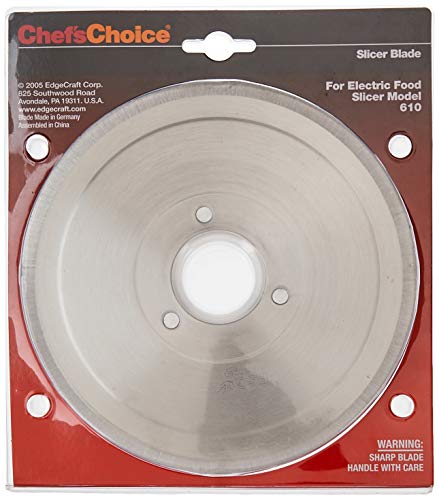
S610012 is a named 7-inch non-serrated replacement listed for Chef’sChoice models 607, 607E, 609, 609E, 610, 6102, 615 and 615A. This is a parts page for existing owners rather than a reason to buy an unidentified new slicer.
When replacing the blade does not solve the problem
Three catalog examples show why the model qualifier matters
A replacement blade can look convincing in a listing photograph and still be the wrong part. The visible circle tells you almost nothing about the back of the hub, fastening arrangement or relationship to the guard. Buying by diameter alone turns the most important compatibility questions into guesses.
This page helps you build a reliable order request. It does not certify any aftermarket blade or provide installation instructions. Begin with the machine’s identification plate and operator documentation; then compare the exact replacement listing. Our care and parts hub organizes this decision separately from shopping for an entirely new slicer.
The first filter is the complete model
Write down the manufacturer, full model designation and serial number. Preserve every suffix, punctuation mark and regional designation. Use a photograph to avoid copying a zero as the letter O. If the original purchase listing used a marketing name, do not assume that name is the model printed on the actual appliance.
A receipt is helpful for locating support, but the physical machine is the item that needs a part. Sellers sometimes group several sizes or revisions on one product page. The fact that your order history opens a similar machine does not prove that its current accessories fit your earlier version. Send the identification photograph to the manufacturer if the documentation is ambiguous.
Use a part number as the buying anchor
Find the blade in the manufacturer’s parts list or obtain a written recommendation from support. Record the part number, whether it includes a hub or fastener, and any serial-range restriction. If a newer part supersedes the old one, ask whether the substitution needs an additional kit or professional installation. A supersession is not always a bare-blade swap.
The reference is useful even when considering a third-party product. It gives the supplier something precise to confirm. A statement such as “fits most 10-inch slicers” does not answer whether the assembly matches your model. Ask the seller to identify the supported model and reference number, then retain the answer with the order.
Eight questions a blade listing must answer
Check
Evidence to obtain
Why a visual match is insufficient
Machine identity
Full model and applicable revision
Related models can use different assemblies
Part reference
Approved replacement or documented cross-reference
A descriptive title is not a parts catalog
Diameter
Specified nominal size for that part
It is only one dimension
Mounting
Correct bore, hub and fastening design
The back may be absent from photos
Blade profile
Correct thickness and offset where specified
A flat circle can sit in the wrong position
Guard relationship
Manufacturer-confirmed suitability
Clearance is not judged safely by trial running
Edge and food use
Approved smooth or serrated option
Matching hardware does not expand permitted foods
Installation
Owner procedure or service requirement
Buying the part does not establish DIY suitability
Use these checks to request documentation, not as an invitation to remove the blade and measure every surface. Measurements involving an exposed edge are unnecessary when the manufacturer can identify the proper part from the machine label. Do not modify holes, grind a hub or add improvised washers to make a questionable blade fit.
Why two same-size blades can fail the comparison
Imagine two listings both described as 7.5-inch stainless blades. One may be a complete geared assembly intended for a particular domestic slicer; the other may be a different mounting design. Even if their outside diameters agree, that agreement says nothing about the drive connection. This is an illustration of the identification problem, not a claim about any listed ASIN.
A second mismatch is subtler: a blade appears to mount but does not occupy the approved position relative to a cover or gauge plate. That is not a successful fit. Rubbing, wobble or a newly exposed gap is a reason to stop and consult service, not to loosen a guard or operate at a thicker setting.
Choose edge style after compatibility
Once a model-approved part is established, consider the food task. A smooth replacement and a serrated replacement are separate options only when the machine manufacturer supports both. Do not select serrations to compensate for using an unsuitable food, such as bone or a frozen block that the equipment instructions prohibit.
The smooth-versus-serrated comparison discusses the food-selection decision. It cannot turn a mechanically incompatible blade into an acceptable choice. Likewise, a coating described in an advertisement does not prove food compatibility, sanitation suitability or better cutting performance on your machine.
Questions to send the supplier
A useful inquiry is short but specific: “My machine is manufacturer X, full model Y, serial Z. The parts diagram identifies blade reference A. Does this exact product replace A on this serial range? Is the hub included? Does the replacement require a different fastener, removal tool or service adjustment?” Attach the identification label and the relevant diagram rather than a close-up taken while handling the edge.
If the reply confirms only the diameter, repeat the unanswered questions. If the supplier cannot verify compatibility, do not buy on the assumption that returns will make a trial installation harmless. Packaging can also become difficult to return once opened, and handling a sharp unsuitable part creates work without resolving the problem.
Inspect delivery before installation
Compare the received part number and packaging description with your order record while the protective packaging remains in place. If the package is damaged, the blade is visibly bent or the item differs from the confirmation, contact the supplier before removing protection. Do not try to straighten a shipping-damaged cutting component.
Follow the manufacturer’s installation route. Some owner manuals provide an approved removal system; other blade or alignment work belongs to a trained technician. Berkel explicitly labels its B-series service manual for qualified service personnel. That distinction is a useful reminder that access to a diagram is not permission to perform every illustrated repair. Berkel B-series service manual.
When replacing the blade does not solve the problem
A deteriorating slice can result from food movement, unsuitable preparation, an incorrect thickness setting or a carriage fault. If the reason for ordering is simply “the slices look worse,” first describe the symptom. The sharpen-or-replace guide separates edge wear from other causes. A new blade should address a diagnosed need, not become an expensive experiment.
For a discontinued machine, ask support whether a documented replacement remains available. If it does not, the safe answer may be professional assessment or retirement. An undocumented near-match is not made acceptable by the age of the slicer.
Three catalog examples show why the model qualifier matters
The manager-supplied OSTBA listings distinguish ASIN B0DP51CCHK, a serrated replacement, from B0DP4VXJNQ, a non-serrated replacement. Both titles identify the SL-518. That is useful purchasing information for someone confirming an SL-518 part; it is not a statement that either blade fits every OSTBA machine or another brand’s 7.5-inch slicer.
The Chef’sChoice S610012 listing, ASIN B000X1EOTO, names models 607, 607E, 609, 609E, 610, 6102, 615 and 615A. Keep that complete listed compatibility scope with the product. Do not shorten it to “universal Chef’sChoice blade,” and do not assume an unlisted model is covered because its number is close.
These are catalog-title claims, not an installation inspection by this website. Before choosing any of them, compare your machine’s identification with the current listing and manufacturer documentation. If your model is absent or its suffix differs, pause the purchase and ask support. The safest comparison table is one that can say “unconfirmed” rather than filling a blank with a plausible guess.