Electric slicers power the blade, but many still require you to move the carriage. Manual machines can suit a narrow task well; they are not all substitutes for an electric deli slicer. Match food compatibility and cut shape before comparing effort.
The befen entry is a hand-operated meat cutter marketed for frozen-meat preparation. It is a different mechanism from an electric circular-blade deli machine, so comparisons should start with the permitted food state, hand force and mounting method rather than watts or blade diameter.
Weston's manual jerky slicer lists an input opening for cuts up to 5 inches wide and 1.25 inches thick. This is an important distinction from a deli slicer: its blade arrangement creates strips from prepared meat, rather than making it a universal substitute for an adjustable circular-blade machine.
This CUSIMAX listing distinguishes itself with two removable 8.7-inch blades and a removable food carriage. It advertises a 1–20mm adjustment range. The practical question is whether the food-contact components you must wash can be removed in a way you are comfortable repeating after each session.
Calculate session time without inventing a speed rating
What electricity changes about the workspace
Safety is not a contest between power sources
Compare these candidates for different reasons
Recurring costs beyond the purchase
Compare interruption and restart, not only continuous cutting
Different foods can require different equipment
Match hand movement to the repeated task
A practical decision rule
The most misleading comparison is “manual is slow, electric is fast.” A manual strip cutter and an electric circular-blade machine may not produce the same food shape at all. Even when both can complete a task, the faster cutting stage can be outweighed by mounting, preparation and cleanup. Compare the job from taking out the machine to putting it away.
Separate blade power from food movement
On many electric food slicers, a motor turns the knife while the operator moves a carriage. An automatic carriage is a separate feature. Do not assume a listing that says electric or automatic means the ingredient feeds itself or that the machine can be left unattended.
A lever cutter uses the operator's motion to bring an edge through a supported ingredient. A crank strip machine draws an appropriately prepared piece through a blade assembly. A flywheel slicer uses hand power through a different mechanical system, generally involving a circular knife and moving carriage. “Manual” describes the power source, not one universal cutting process.
Use output as the first filter
Your intended result
Manual path to investigate
Electric path to investigate
Hot-pot slices
A lever model with explicit food-state instructions
An exact model documenting the intended ingredient condition
Jerky strips
Crank strip cutter or guided knife
Compatible slicing machine followed by a separate strip-cutting step
Repeated sandwich slices
Suitable circular-blade flywheel equipment
Home or deli circular-blade slicer approved for the food
Several foods in one session
Check each food independently; one mechanism may not cover all
Check food restrictions and cleaning transitions, not just motor size
For example, a crank cutter that produces parallel jerky strips may complete that specific transformation directly. A circular-blade machine might first produce slabs that still need cutting into strips. Counting blade strokes would favor one machine unfairly; counting finished usable output reveals the real workflow.
Map the work you will still perform
Both approaches can require trimming, shaping and portioning the ingredient before it reaches the machine. Both need a stable surface, a clear receiving area and the correct holder. Both leave a final piece that must be handled according to the instructions. Neither removes the need to keep raw ingredients and ready-to-eat foods appropriately separated.
Electric power can reduce the repeated force needed to drive a blade, but it does not eliminate the need to guide food. Manual power avoids a cord and motor, but can concentrate effort in a shoulder, wrist or hand. The relevant question is whether you can comfortably perform the documented motion while remaining in control, not whether you can force through one impressive cut.
If two adults will use the equipment, evaluate both working positions. A machine comfortable for one person's height and dominant hand may be awkward for the other. Control placement, counter depth and receiving-tray position can matter more than a small difference in advertised power.
Calculate session time without inventing a speed rating
Use five entries: retrieval and mounting, ingredient preparation, cutting, cleaning and storage. Add them to obtain total active time. Then divide usable output by that total if you want a personal productivity figure. Keep waiting time for food preparation separate from active work, while recognizing that it still affects when dinner can start.
As an illustration, suppose a session takes 4 minutes to set up, 6 to prepare ingredients, 8 to cut and 12 to clean and store. That is 30 minutes of active work. Halving the cutting stage saves 4 minutes, not half an hour. These are hypothetical numbers, not measured performance of any product. Their purpose is to show why cleaning access deserves a place beside cutting convenience.
Repeat the comparison for your normal batch and your occasional large batch. Buying primarily for a once-a-year event can leave you with cumbersome equipment for the other fifty weeks. Conversely, equipment that feels adequate for one serving may be frustrating for recurring meal preparation.
What electricity changes about the workspace
An electric machine needs a suitable supply and a cord route that remains clear of food, water and moving components. Follow its electrical instructions and do not place it where the cable pulls the machine toward an edge. A manual cutter needs no outlet, but its mounting and operating forces still have to be supported by the furniture.
Storage is also different from operating clearance. A compact electric slicer can require substantial carriage travel. A lever handle can reach beyond a narrow base. A crank needs room through its full rotation. Compare working envelopes with protective components fitted, not promotional images that crop out the handles.
Safety is not a contest between power sources
Removing a plug isolates electrical power; a manual edge remains sharp without any electrical connection. A hand-powered mechanism can still trap fingers or release a loaded handle unexpectedly. For either system, preserve guards, use the intended holder and stop before trying to clear a blockage.
A larger electric motor is not authorization to process harder food. Berkel's published guidance, for example, advises against frozen products because of potential blade damage. That illustrates why food compatibility must come from the actual machine's instructions rather than the category name or wattage.
Compare these candidates for different reasons
Befen B07BPVKK5H represents the catalog's manual frozen-meat category; Weston B001SGB3SS represents a manual jerky-strip approach. They should not be ranked as direct equivalents. Their operating instructions and final cut shapes determine which belongs in a particular kitchen.
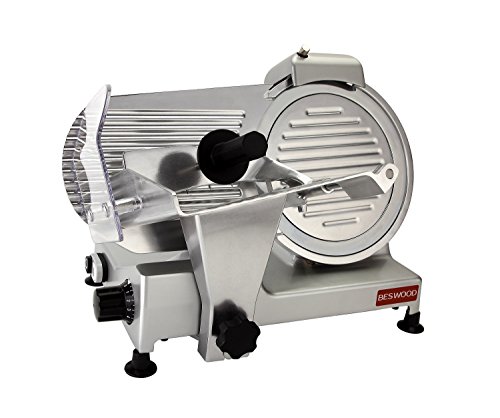
CUSIMAX B0C4YKDMDM is listed as an electric home slicer with two removable 8.7-inch blades and a removable carriage. BESWOOD B01AQH636Q is identified as the BESWOOD250 with a 10-inch blade. Those listing distinctions suggest different formats to investigate, but they do not prove speed, food compatibility, commercial approval or durability. Confirm the exact variant and manual before deciding.
The meaningful shortlist could therefore contain only two products: the best-documented candidate for your required manual process and a compatible electric alternative. Adding several visually similar lever cutters does not create a more informative comparison.
Recurring costs beyond the purchase
Record replacement-blade availability, any sharpening requirements, cleaning materials specified by the maker and storage needs. Do not assume a manual blade is cheaper to replace, or that any round blade with the right diameter fits an electric machine. Mounting patterns, bore dimensions and other model-specific details matter.
Electricity cost should be evaluated using actual power and usage data if it matters to your decision. An advertised wattage is not a complete ownership-cost calculation. For occasional home use, avoid building an elaborate financial conclusion from guessed operating hours or unverified product prices.
Compare interruption and restart, not only continuous cutting
Home preparation rarely happens as one uninterrupted demonstration. You may need to collect a receiving container, check another dish or change ingredients. Consider how the manual says to stop, secure and restart the equipment. A workflow that requires an awkward sequence every time may matter more than the cutting speed.
Do not treat pauses as permission to leave the blade accessible. Follow the equipment's safe unattended state even during a short interruption. With electric equipment, understand the switch and isolation procedure. With manual equipment, understand how the handle, wheel or blade is secured.
Different foods can require different equipment
A shopper who wants hot-pot slices, bread and cooked deli meat may be asking one machine to cover incompatible processes. List each food separately and verify its approval. If no model covers the combination, compare a narrower machine plus another preparation method with the inconvenience of changing equipment.
Do not count a use as covered merely because it appears in a broad title. For delicate foods, the holder and blade arrangement matter; for firm foods, the permitted condition matters. Electrical power cannot bridge an undocumented compatibility gap.
Match hand movement to the repeated task
A lever stroke, a crank rotation and a hand-fed electric carriage ask different things of the operator. Watch the documented motion through its complete range before choosing. Consider where the hand begins and finishes, whether the receiving container can stay clear, and whether the ingredient remains controlled by the intended holder.
Do not infer ease from a demonstration showing only a few cuts. A movement that feels acceptable once may become inconvenient when repeated through the normal batch. Conversely, avoiding every manual motion is not possible merely by powering the blade: a hand-fed electric carriage still has to be operated deliberately.
For a household with a particular movement limitation, the practical question is which documented motion can be performed comfortably while maintaining the required grip and position. A machine is unsuitable if operating it requires abandoning its holder or changing the prescribed hand placement. Choose another format rather than modifying the mechanism to compensate.
A practical decision rule
Choose manual when a specific documented mechanism handles your normal food and cut shape with acceptable effort and cleanup. Choose electric when a compatible machine meaningfully improves your recurring workflow and fits your space. If neither has clear instructions for the food you intend to cut, the correct decision is to keep looking.
The BESWOOD250 occupies the step between a lightweight food slicer and a larger deli machine. Its listing identifies a 10-inch chromium-plated blade and 240W motor. The buying decision is whether that larger format earns its place on your counter through regular slicing, rather than whether a bigger blade looks more professional.